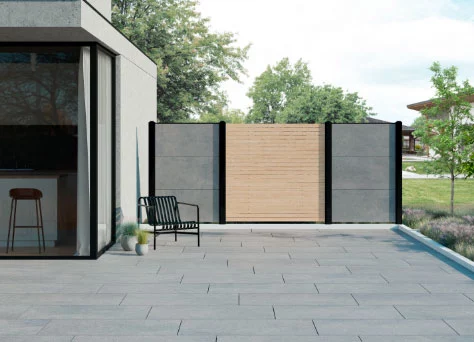
„Anthrazit“ ist die Farbbezeichnung für ein sehr dunkles, fast schwarzes Grau. Ursprünglich stammt der Begriff aus dem Englischen und bezeichnet eine harte Kohleart mit metallischem Glanz (deutsch: Schwarzkohle).
Terrace tiles in anthracite: modern and elegant
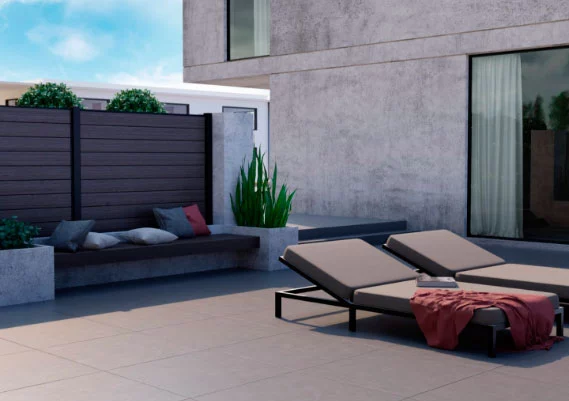
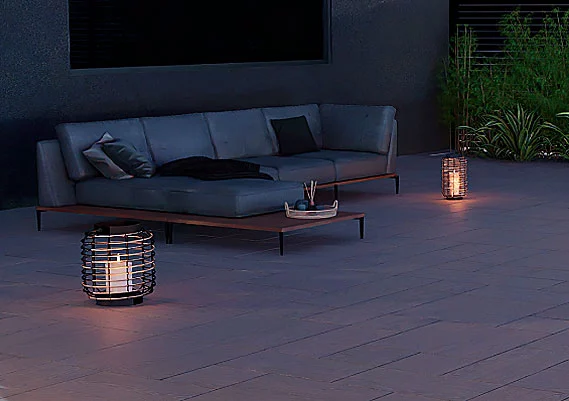
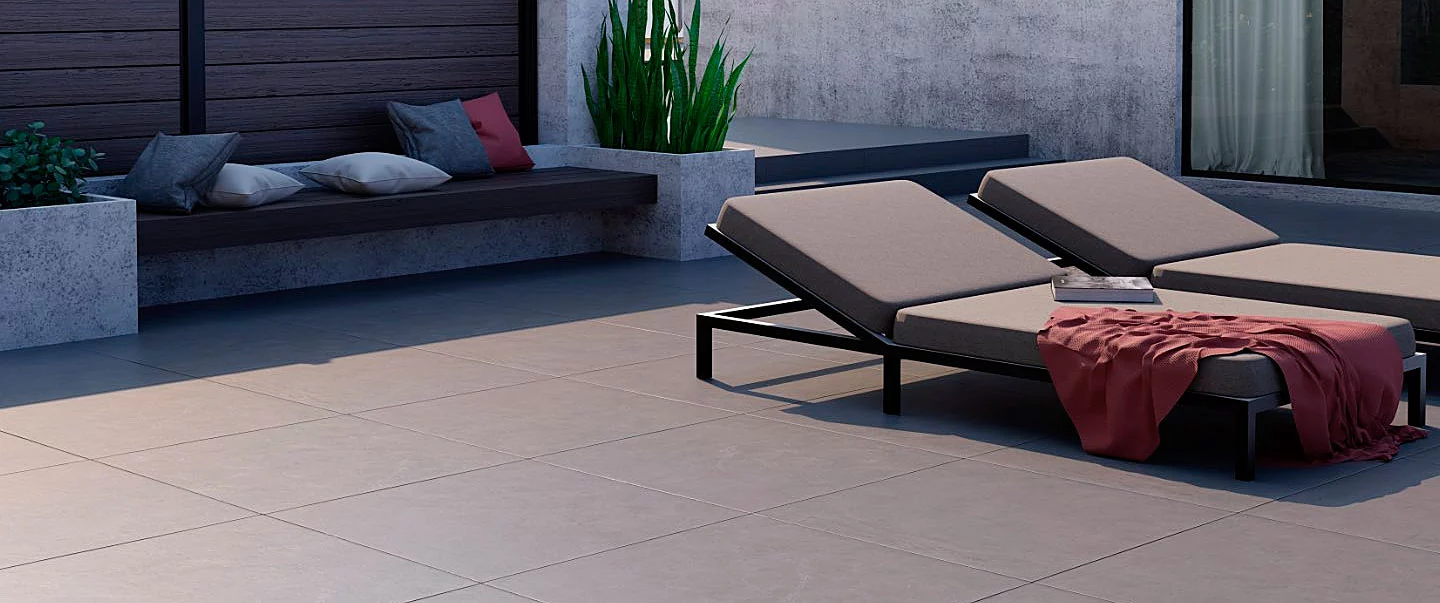
Anthracite-coloured tiled floors are a real eye-catcher, not only in bathrooms but also on patios. They look stylish and complement almost any architectural style, from modern to classic. No wonder they are currently among the most popular modern patio flooring options. They are available in a wide range of sizes and styles.
What should you look out for when choosing anthracite-coloured patio slabs?
‘Anthracite’ is the colour name for a very dark, almost black grey. The colour itself is also its main drawback: dark slabs heat up significantly when exposed to sunlight. Walking barefoot across the patio is virtually impossible on hot summer days. The heated surface can even damage adjacent plants and potted plants. We are familiar with this heat-retaining effect from hot tarmac surfaces in summer. The most important criteria are therefore the careful selection of the shade of grey (does it really need to be almost black?) and taking the terrace’s orientation into account. Exposed south-facing areas and roof terraces are not necessarily suitable. Where possible, you should also ensure there is sufficient shade, for example through trees, privacy screens or canopies.
What types of patio flooring are available in anthracite?
Tiles in anthracite are available as natural stone, porcelain stoneware or even concrete. Natural stone has an unrivalled appearance and always exudes a special charm. Porcelain stoneware tiles are characterised by their excellent low-maintenance properties and wide variety. They are generally more affordable than natural stone. Alternatively, you might consider a floor made of WPC planks. These are also available in anthracite.
Naturally beautiful: natural stone in anthracite
When it comes to natural stone, slate is the best-known type of stone in anthracite. It offers a unique surface texture and, depending on the variety, a matt sheen. Granite is also a grey natural stone, but its appearance is not quite as uniform; however, it is exceptionally hard and robust. Basalt can also be used for patios. It is weather-resistant and available in various shades of grey, from light to dark. Basalt is a volcanic rock. Its distinctive surface makes it a very attractive choice for Roman-style paving. Our tip: Most natural stones are also available as reproductions made from easy-to-maintain porcelain stoneware.
These natural stones are available in anthracite:
|
|
Porcelain stoneware tiles in anthracite: a wide selection
Porcelain stoneware tiles are available in almost every conceivable colour and texture. Some mimic the look of grey natural stone (and are named accordingly), whilst others have a more modern and minimalist feel. In fact, some porcelain stoneware tiles can be used both indoors and outdoors, allowing for seamless transitions between spaces. The colour names reveal little about the type of tile and are often simply the manufacturer’s own designations. Due to the wide variety available, it is essential to view and feel porcelain stoneware tiles in a specialist shop. There are significant differences. Porcelain stoneware tiles are a type of ceramic tile and are not natural stone.
Concrete slabs in anthracite: modern chic
Concrete slabs are a classic choice for patio flooring, and they literally carry quite a bit of weight. A slab in a typical size, such as 50 x 50, weighs just under 30 kg. The reason for this is their thickness: concrete slabs are usually at least 5 cm thick. Untreated concrete slabs are quite delicate. The surface is therefore usually sealed, a process that needs to be repeated to prevent signs of wear and tear. Concrete slabs are available from 12–15 euros per square metre. Coloured (dark) varieties are significantly more expensive, particularly if they have also been ground, polished or sealed. Concrete is available in numerous varieties and colour shades. Some surfaces even resemble ceramic tiles with a matt sheen. Suitable substrates include drainage mortar, a loose gravel bed or pedestal supports.
Conclusion
The look of a dark patio floor is unique. However, you should think carefully about whether this will significantly limit how you can use your patio. After all, the slabs will become very hot in summer. This means that young children, in particular, will not be able to enjoy spending time on the patio without any worries. If you want to find out for sure, start by ordering a few sample slabs (in various shades of grey), lay them out in the planned patio area during the summer months and test how much heat they retain. Incidentally, quartz sandstone, granite, quartzite and gneiss release heat slightly faster than ceramic tiles. As for the flooring material, it is otherwise purely a matter of personal taste whether you opt for porcelain stoneware, natural stone or concrete. Concrete and natural stone require slightly more care and maintenance. In general, you should also ensure there is sufficient shade, for example through trees, privacy screens or canopies. And don’t forget: global warming is already making summers increasingly hotter. A cool seating area is therefore a great way to relax.
That’s what matters
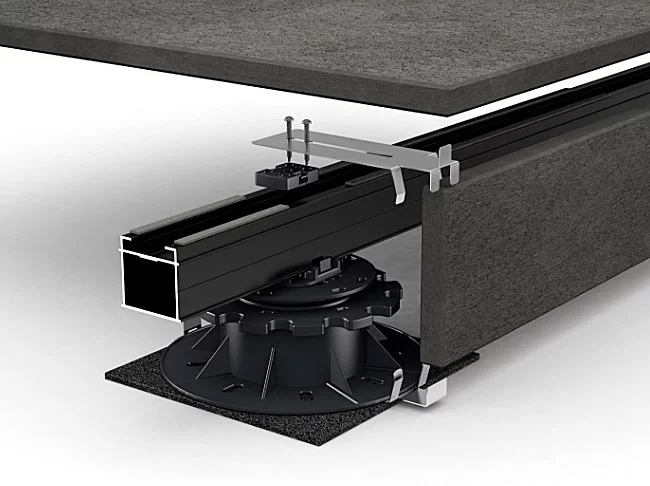
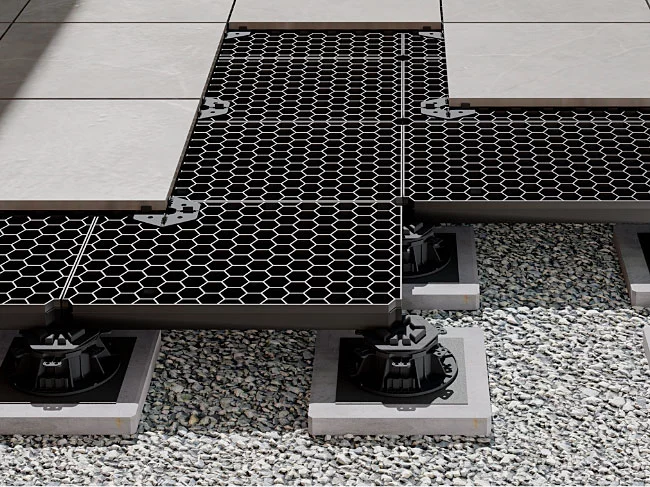
Beware of light shining through! When laying on pedestals, the joints remain open. Light-coloured, translucent aluminium or plastic elements spoil the overall look. That is why the aluminium profiles for our TRIAS ALU substructure are also available in black – even in the slim version. The grid elements of the TRIAS WABIC substructure are also made from dark-coloured material. We generally recommend using a gap cover for tiled floors laid on pedestal supports. It also makes installation much easier, as the tiles can be positioned freely across the continuous surface of the grid panels.
TRIAS WABIC
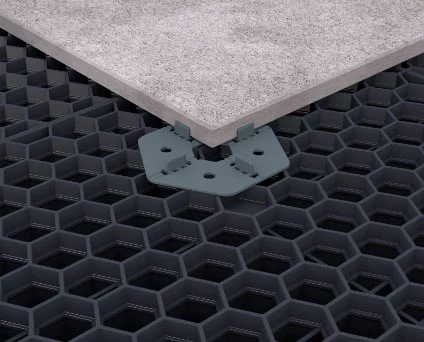
The Trias Wabic decking substructure offers effective fall-through protection for decking with slab paving. The system allows for creative laying patterns. This is made possible by the ‘X-Pad’ laying crosses, which can be positioned freely across the surface.
View the installation system
TRIAS WABIC: Perfect for attractive tiled surfaces
Tiles of a wide variety of sizes can be laid freely on the uniform base surface made up of grid elements. The system’s X-Pads (laying crosses) can be positioned as required and allow for a wide variety of laying patterns. A range of joint widths is available.
Was ist Anthrazit für eine Farbe?


Worauf muss man beim Kauf von Terrassenplatten achten?
Unbedingt ausreichend Material einkaufen. Insbesondere bei Naturstein kann es beim Nachkauf zu erheblichen Farbunterschieden kommen. Für die einfache Bedarfsplanung steht der TRIAS Konfigurator zur Verfügung. Wichtig ist es, auch den Verschnitt einzuplanen und genügend Reserveplatten zu bestellen. Schließlich kann auch mal ein Fehler passieren oder man hat sich verkalkuliert. Es ist unangenehm das Projekt wegen weniger Platten nicht abschließen zu können. Erkundigen Sie sich im Fachhandel außerdem, ob eine Oberflächenversiegelung notwendig ist.
Gibt es auch Terrassendielen in anthrazit?
Ja, beispielsweise als WPC oder BPC. Die Struktur kann gerillt, feinstrukturiert oder holzähnlich gemasert sein. Für Dielen empfehlen wir die Unterkonstruktion TRIAS ALU. Der Multiclip-T des Systems passt zu Dielen mit Nut. Dielen ohne Nut können direkt auf den Alu-Profilen verschraubt werden.
Eignen sich Terrassendielen in anthrazit für den Balkon?
Bei exponierten Südlagen würden wir davon abraten. Dunkler Boden kann sich bei Sonneneinstrahlung stark erhitzen. Darunter leidet dann auch das Innenraumklima. In heißen Sommern kann über den Balkon nicht mehr gut gelüftet werden. Hellere Grautöne sind idealer für Balkone und Loggias. Auch Dachterrassen sind häufig sogar durchgängig der Sonneneinstrahlung ausgesetzt. Dunkle Böden haben lange Zeit sich aufzuheizen.
Welche Formate gibt es für Fliesen in anthrazit?
Bodenfliesen in anthrazit gibt es in nahezu allen Größen. Beliebt sind quadratische Formate. Typische Plattenformate sind außerdem: 20x80, 20x114, 20x120, 30x120, 20x160 oder 40x160 cm. Grundsätzlich muss beachtet werden, dass längliche Fliesen eine leichte Krümmung aufweisen können, sie sind also etwas schwieriger zu verarbeiten.
Welche Verlegemuster passen zu Fliesen in anthrazit?
Fliesen in Anthrazit werden auf Böden häufig in schlichten, klaren Verlegemustern eingesetzt. Dazu gehört der Halb-, Viertel oder auch Drittelverband. Besonders minimalistisch sind strenge Kreuzfugen. Sie wirken umso edler je größer die Plattenformate sind. Aber Achtung: Die Größe der Plattenformate sollte immer im Verhältnis zur Größe der Terrasse stehen.
Wodurch sind manche Natursteine dunkel?
Die mineralische Zusammensetzung bestimmt den Farbton. In dunklen Natursteinen ist häufig der höhere Anteil an Corderit oder Betonit für die dunkle Farbe verantwortlich.