
Der Prozess der Umwandlung von Licht in Strom wird „Photovoltaik“ genannt. Eine Photovoltaikanlage (auch PV-oder PVA-Anlage) generiert elektrische Energie aus Sonnenlicht. In den Solarzellen befinden sich Elektronen, die durch Licht in Bewegung versetzt werden. Durch die Bewegung der Elektronen entsteht elektrische Spannung in Form von Gleichstrom.
Efficient and attractive: TRIAS solar privacy screens
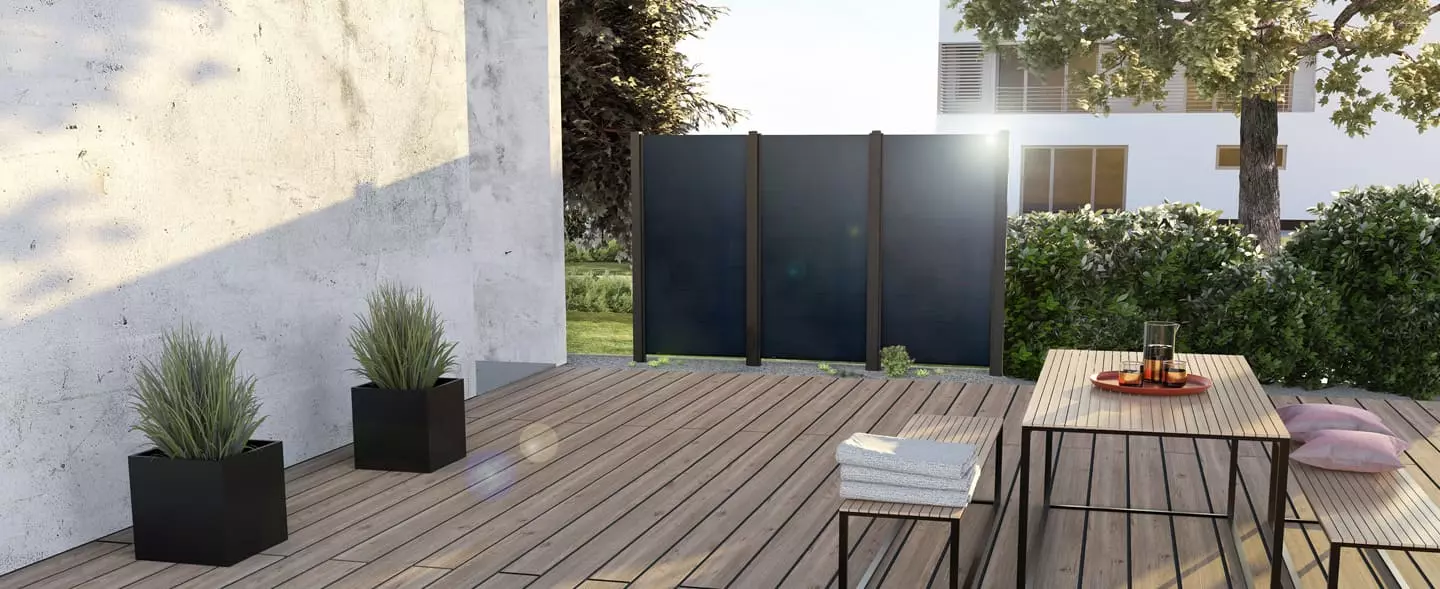
Why not simply add solar panels to your TRIAS privacy screen? This way, you can integrate your own private solar power station attractively into your garden design. With the right add-on modules, installation is incredibly simple. Find out here which solar panels are best suited and whether the investment is worthwhile.
Key points at a glance
How does the TRIAS solar privacy screen work?
Standard solar panels can be combined with the TRIAS privacy screen posts. The panels are fitted between the posts, just like the privacy screen panels. You can replace individual or multiple panels of the privacy screen with solar panels. Alternatively, solar panels can be mounted in front of the screen, as with a balcony balustrade.
Which modules are best?
As an alternative to the panels, we recommend so-called bifacial glass-on-glass modules, as they can be used on both sides. The modules are best positioned in an east-west direction. For a purely south-facing orientation, single-sided solar modules can be used. However, they are not particularly attractive on the reverse side and are more suitable as a suspended version. Please note: Solar modules vary greatly in terms of value for money; seek advice from specialist retailers on the different performance types.
You can configure your integrated privacy screen and solar power system yourself. There are numerous possible combinations. TIP: When planning in the configurator, use an HPL panel as a placeholder. Please note: The dimensions of the HPL modules do not correspond to those of the solar modules. Simply adjust the calculation accordingly.
Budget planning and efficiency
As with any gardening project, cost plays a key role when it comes to a solar privacy screen system. However, solar privacy screens have an advantage over other garden projects: the investment pays for itself, as the privacy screen ‘works for you’. It helps you save on electricity bills day after day and even contributes to climate protection.
When does the TRIAS solar privacy screen pay for itself?
A solar privacy system pays for itself on average after 4–7 years, which means that the initial costs are recouped within this period. The investment therefore pays off after a relatively short time. Don’t forget: the performance and location of the panels play an important role.
How much does the TRIAS solar privacy screen cost, and what does it offer?
Assuming that a simple, bifacial module costs around 100 euros, the privacy posts a further 200 euros and the accessories around 50 euros, this results in a total cost of 350 euros per unit. Assuming an average of 5–6 hours of sunshine per day and a daily yield of 0.6 kWh, even a simple module would generate an annual yield of around 60 euros per module. The more modules installed and the higher their quality, the greater the yield. The length of the fence has a positive effect. A privacy extension panel is significantly cheaper, as only one additional post is required. (Example: a starter panel with two posts + module costs approx. €350; an extension panel with one post + module therefore costs only €250). PLEASE NOTE: All prices quoted here are illustrative estimates. Actual costs vary depending on the system and quotation.
A solar system for the roof, balcony or privacy screen?
Investing in a large rooftop solar panel system can certainly be expensive. Small solar panel systems comprising just a few panels are less costly and therefore a good alternative. They can be used as a first step or as a supplement.
How much energy can I generate with a small solar panel system?
This depends on the output, the number of modules, the location and the number of days with sunshine. Ideally, a high-quality mini-system comprising just a few modules can cover up to 20 per cent of your energy requirements. Be sure to ask the manufacturer about the performance of the solar systems.
How do the costs of photovoltaic systems compare?
Smaller systems, such as balcony solar panels (with an output of 600 to 800 watts), cost between 500 and 900 euros. There are panels available for under 100 euros. Prices may vary depending on the manufacturer and output. Look for the best value for money and compare prices carefully. As a rough guide, you should expect to invest between 1,200 and 1,800 euros per kilowatt of electricity. By way of comparison: a medium-sized rooftop PV system (without a battery) costs around 10,000 euros, plus ongoing maintenance costs.
How much does it cost to install a solar panel system?
Installing a medium-sized solar panel system on a roof usually costs between 1,500 and 3,500 euros. Prices vary considerably. Integrating solar modules into privacy screens, on the other hand, does not necessarily have to be carried out by a specialist. With the right add-on modules from TRIAS, installation takes no longer than it does to fit an HPL module. On top of this comes the installation of the electrical system.
Sie haben Fragen zur Sichtschutz-Planung?
On the roof
Roofs offer large, open spaces. Both pitched and flat roofs can be used, and even garage roofs are suitable for a solar installation. The advantage of a roof is its large surface area with minimal shading – the disadvantage is the greater effort required for installation and maintenance.
Balcony or roof terrace
On balconies and roof terraces, solar panels are usually mounted on a support frame. They are fitted to the parapet. As a tenant, you will need to check with the relevant property management company or the owner to see whether this is permitted. In most cases, only 1–2 panels can be installed. These should, at the very least, have a higher output.
Freestanding in the garden
Solar panels can be set up freely in the garden. This allows them to be moved to follow the sun. Simple frames without anchoring are not suitable for higher wind loads. Free-standing modules also take up extra space in the garden. Installation, on the other hand, is very simple: set them up, plug them in, and you’re done.
As a privacy screen or fence
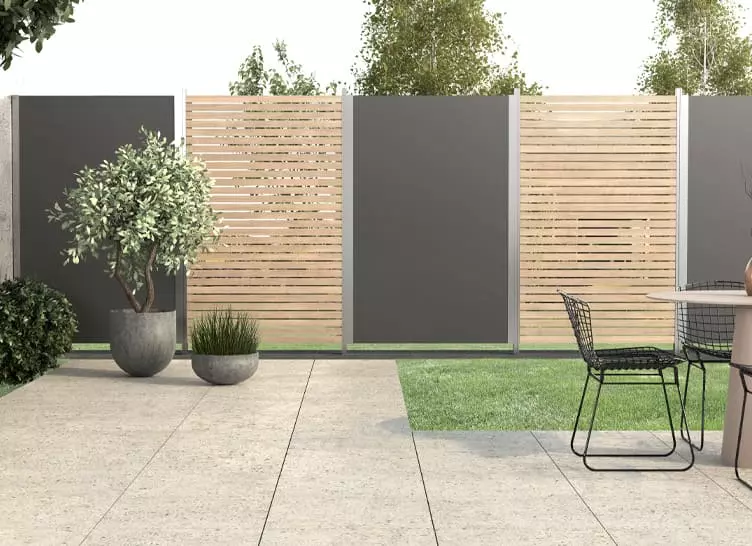
The TRIAS privacy screen system allows solar panels to be integrated into the privacy screen. This means they are barely noticeable, require no extra space and become a decorative feature in the garden. You can replace just a few or as many panels as you like in your privacy screen, depending on your preference. Combine other materials from the TRIAS privacy screen system to create your own personalised solar privacy screen. Instead of attaching the panels directly to the posts in place of the infill panels, you can also mount them in front of the posts – much like on a balcony. For this, choose sturdy infill panels, for example made of aluminium (Rhombus Alu, etc.).
Which direction?
Ultimately, it is the local conditions that determine where the most sunlight falls. Here’s a tip: if you use more electricity in the morning, you can orient your system towards the south-east. If you use more electricity in the evening, face it westwards. The sun is lower in the sky in the east and west. This is perfect for vertically positioned modules, such as those in the solar privacy screen system. Bifacial glass-on-glass modules (usable on both sides) are ideally installed in an east-west orientation. If you opt for a single-sided module, we recommend a south-facing orientation for optimum performance.
Conclusion: The best position for your solar panels
The best location is generally one that is free from shade and receives plenty of sunlight. Observe potential sites closely throughout the day and bear in mind that the amount of sunlight and the angle of incidence change throughout the day and across the seasons. Bifacial (‘double-sided’) modules are positioned in an east-west direction, whilst single-sided modules face south. Whether you opt for a roof-mounted or privacy screen system is, in particular, a cost consideration. Installing a larger system on the roof represents a greater investment. Another tip: privacy screen and roof-mounted systems can be combined. Smaller systems are a good place to start.
How does the TRIAS SOLAR privacy screen work?
You are free to choose your solar panel from any retailer. It is attached to the posts using a mounting bracket. The panels should be the right size to fit the TRIAS privacy screen system. You can replace all or just some of the elements of your privacy screen with solar panels.
The matching posts from the TRIAS privacy screen system
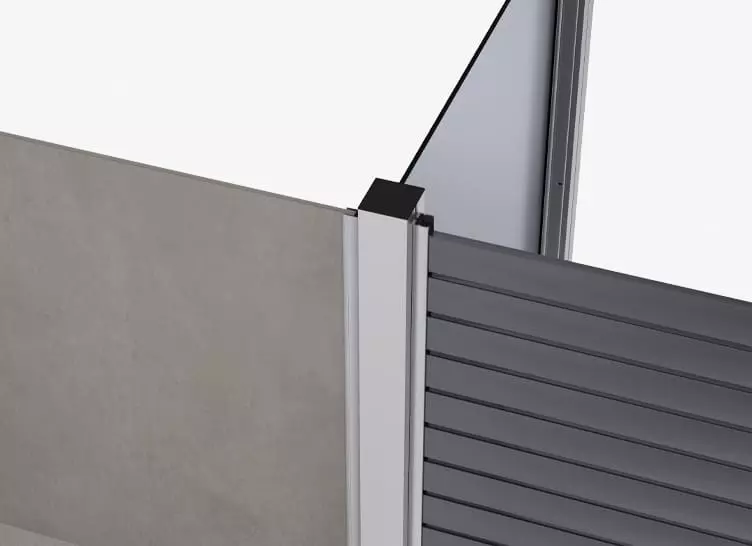
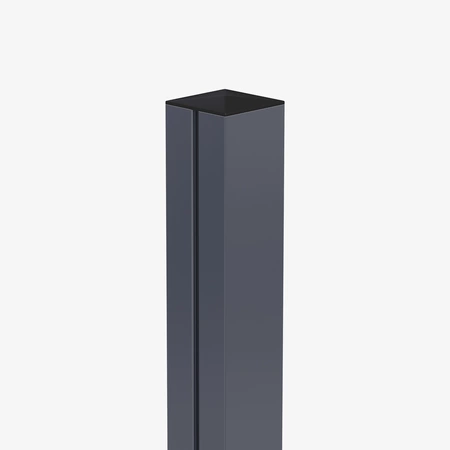
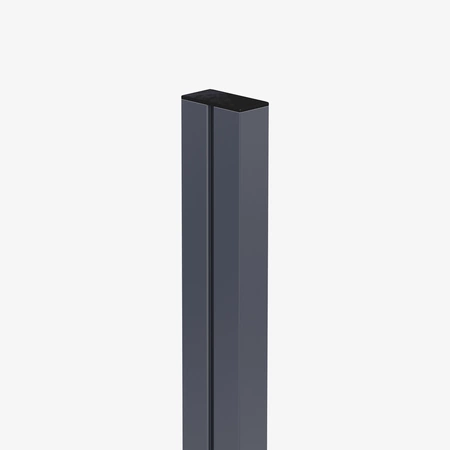
The TRIAS privacy screen system offers a choice of two thicknesses of privacy screen posts. The SLIM version is slimmer and features a T-slot on two sides, whilst the slightly wider posts of the SQUARE version have a slot on three sides. Attachment modules can be fixed into the slot. Both variants can be used for a solar privacy screen. Posts are available in three finish colours: aluminium, anthracite and black (Black Line by TRIAS). Depending on the ground conditions, the posts are combined with suitable post supports. The TRIAS wall connection ensures a seamless transition to the house wall. An overview of the posts and accessories can be found here.
Which modules are the most effective?
To ensure maximum efficiency, it is advisable to use so-called bifacial glass-on-glass modules, which are installed facing east-west. These special modules are characterised by the fact that they can be used on both sides. This means that there is no need to mount a second module on the rear. Bifacial systems not only look sleeker, they are also significantly more efficient.
Which solar panels are compatible with the TRIAS privacy screen system?
Using the TRIAS mounting bracket, almost any standard photovoltaic module can be fitted to the privacy screen posts. You can also combine your privacy screen with other elements of the privacy screen system. Always consult a specialist to ensure that the combination is compatible.
With TRIAS’s add-on modules, PV panels can be integrated into the privacy screen with ease. The add-on modules are available in the three system colours.
The base posts of the TRIAS privacy screen system can accommodate a wide variety of materials, depending on the add-on modules. This means you can alternate between installing solar modules and other elements of the system. You can try out ideas in the configurator. You can use an HPL module as a placeholder for the solar panel. Adjust the dimensions later (the solar panel may be wider or narrower than our HPL element).
What size should the modules be?
The width can be adjusted to suit your needs by varying the spacing between the posts. Only the height should match that of the other connecting elements. This creates a uniform look.
Installation of the solar panels
Assemble your privacy screen as described in the assembly instructions. You can find the assembly instructions in our service section.
Combination options with TRIAS privacy screens
TRIAS’s modular system allows for numerous combinations. You can plan your own custom design using the configurator. In the configurator, replace the solar module with a TRIAS HPL module to get a good idea of how it will look. Be sure to adjust the dimensions to match the actual width of the solar modules. You can save your custom configuration and use it when selecting the appropriate modules. It is essential that the heights match. The width of the solar modules can be easily adjusted to match the post spacing. Try out different combinations.
Configure your privacy screen now View privacy screen modules
What maintenance does the TRIAS solar privacy screen require?
To ensure that your solar privacy panels function optimally and deliver long-term performance, regular maintenance is essential. Here are a few tips:
Clean regularly
Check the surface of the modules regularly for dirt and, if necessary, clean them with a soft cloth and water. Avoid using harsh cleaning products to prevent damage. Please note: Dirt blocks out the sun and acts like a shadow.
Monitoring performance
Keep an eye on the performance of your solar privacy panels and check regularly to ensure they are working as expected. Look out for any signs of shading or damage that could affect their performance.
Was bedeutet Photovoltaik?


Photovoltaik- oder Solaranlage?
Im Prinzip ist auch eine Photovoltaikanlage eine Solaranlage. Bei einer Solaranlage wird Sonnenenergie ganz allgemein in andere Energieformen umgewandelt. Es kann entweder Strom oder Wärmeenergie erzeugt werden. Bei einer Photovoltaikanlage wird mit Hilfe von Licht nutzbarer Strom generiert.
Stecker-Solar- oder Mini-PV-Anlage?
Bei einer Steckersolaranlage braucht man keine aufwändige Technik. Das Panel wird einfach per zugehörigem Anschlusskabel mit einer Steckdose verbunden. Die Leistung solcher Anlagen ist geringer, als die einer großen Photovoltaikanlage. Eine Mini-PV-Anlage oder Steckersolaranlage, wie sie typischerweise als Balkonkraftwerk installiert wird, besteht lediglich aus 1–2 Panelen. Dennoch lassen sich mit ihr bis zu 20% des Energiebedarfs decken.
Was ist ein Solar-Sichtschutz?
Ein Solar-Sichtschutz ist eine Kombination aus PV-Modulen mit einem Sichtschutz-System. Sie können Ihr Sichtschutz-Kraftwerk als Alternative oder gemeinsam mit einer Photovoltaik-Anlage auf dem Dach einsetzen. Es ist möglich, nur wenige Module eines Sichtschutzes durch Photovoltaik-Panele zu ersetzen oder den gesamten Sichtschutz zu nutzen. Konfigurieren Sie einfach Ihr Design nach Wunsch.
PV-Module am besten auf dem Dach?
Die Fortschritte im Bereich der erneuerbaren Energien haben in den vergangenen Jahren zu signifikanten Entwicklungen im Bereich der PV-Anlagen geführt. Obwohl kleinere PV-Sichtschutzanlagen etwas weniger ertragreich sind als große Dachanlagen, stellen sie dennoch eine kosteneffiziente Investition dar. Tatsächlich kann der Ertrag bei senkrecht aufgestellten Modulen im Vergleich verschattungsfrei montieren Modulen auf dem Dach mit ganztägiger Sonneneinstrahlung, rund 20–35% geringer ausfallen. Dieser Wert ist nicht zu verallgemeinern und stark von den gewählten Modulen sowie der Bausituation abhängig.
Zu welcher Tageszeit erzeugt ein PV-Sichtschutz am meisten Strom?
Flache PV-Anlagen auf dem Dach, produzieren während der Mittagsstunden viel Strom, weil die Sonne steil auftrifft. Ein PV-Sichtschutz erzielt die besten Erträge während der Morgen- und Abendstunden, wenn die Sonne tief steht.
Strom erzeugen trotz schlechter Lichtverhältnisse?
Um sicherzustellen, dass der PV-Sichtschutz auch bei ungünstigen Lichtverhältnissen gute Erträge liefert, ist eine Parallelschaltung der einzelnen Module unerlässlich. Dies gewährleistet eine kontinuierliche Stromerzeugung, selbst wenn bestimmte Teile des Zauns verschattet sind. Eine sorgfältige Planung und Installation sind daher entscheidend, um die Effizienz und Leistungsfähigkeit des PV-Sichtschutzes zu maximieren.

