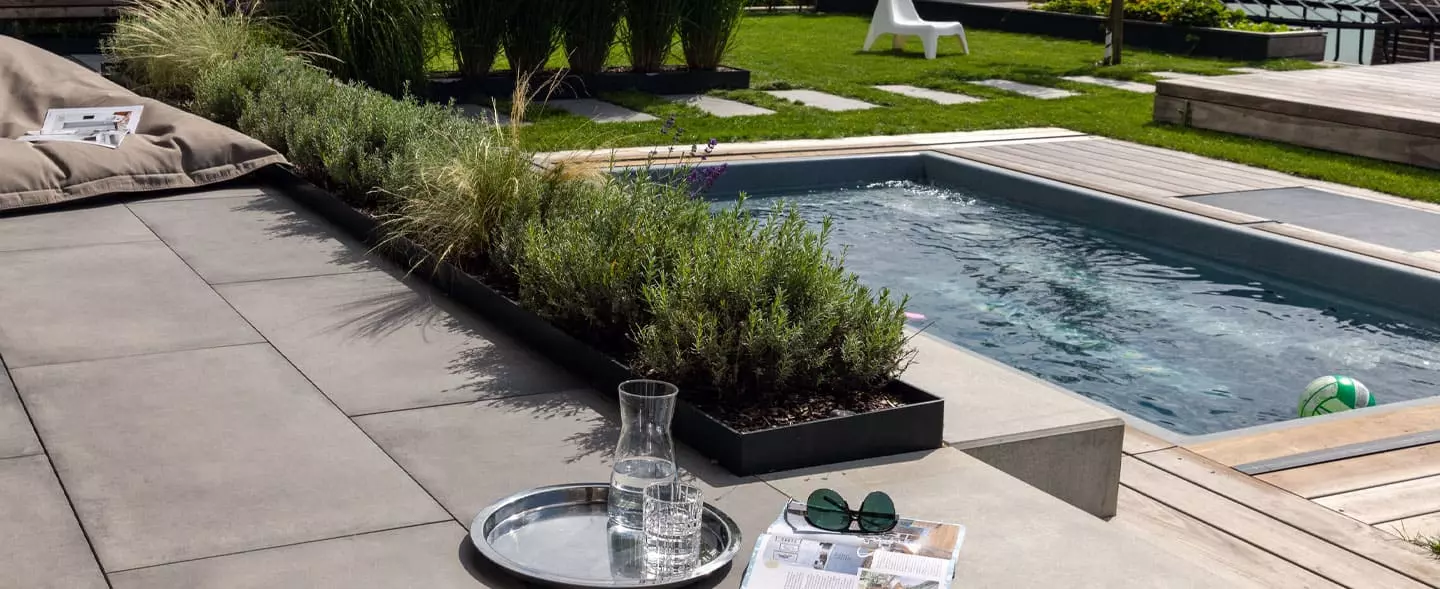
- Careful planning: Having your own swimming pool requires careful planning to create a long-term, functional solution that you can enjoy for many years to come.
- Edging and surrounds: The design of the pool area is crucial. Popular options include terraces that wrap around the pool, as well as platforms and walkways that incorporate different levels.
- Choice of material for the substructure: Aluminium is often used for a durable pool terrace, as it is stable, weather-resistant and maintenance-free. Systems such as TRIAS ALU offer a flexible and stable substructure.
- Choice of decking: Wooden or WPC boards can be screwed down invisibly, whilst stone and ceramic decking slabs can be laid securely even over large spans.
- Safety and stability: Load-bearing capacity is crucial, particularly for deep pools and above-ground pools on roof terraces. Systems such as TRIAS WABIC offer solutions for distributing the weight safely.
From the sun lounger onto the pool and straight back again! On hot summer’s days, there’s probably nothing more refreshing. Later in the day, you can enjoy the cooler temperatures with your feet in your own pool and a sundowner in your hand. But let’s be honest: most of the time, we spend more time by the pool than in it. So the surroundings need to be just right, with the patio, pool and garden forming a harmonious whole.
So if you’re thinking about enhancing your home with your own pool, there’s no getting round careful planning. At least not if you’re aiming for a long-term solution that will offer family and friends genuine enjoyment of the water for many years to come.
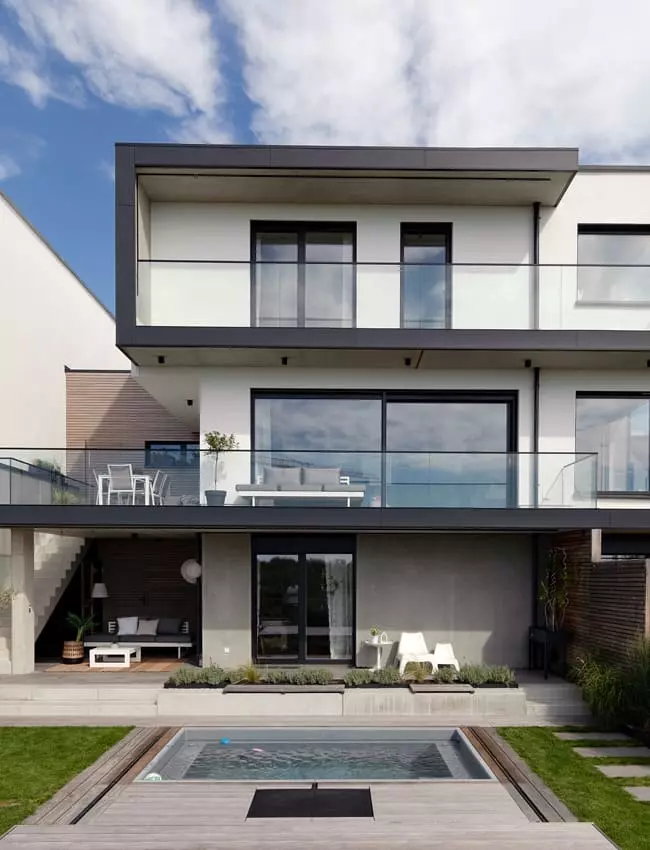
One key consideration here is the edging or border around the pool. Many designers and homeowners opt for pool designs in which an entire terrace is elegantly arranged around the pool. Designing on different levels using platforms, steps and walkways is also a popular way of creating genuine oases of well-being and relaxation. With the right substructures, there are virtually no limits to the possibilities, and various surfacing materials such as stone, timber or WPC can be laid and combined with one another.
Even simpler enclosures for so-called above-ground pools can be planned very effectively using multi-level substructures, significantly enhancing the garden pool both visually and functionally.
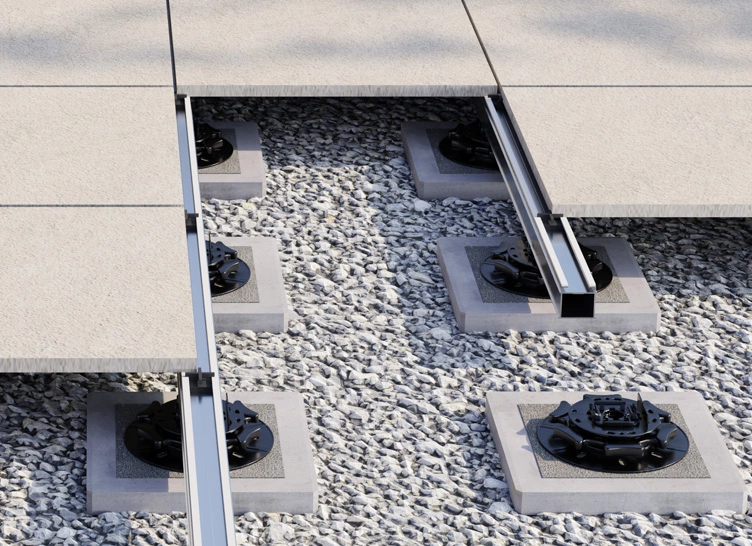
If you want to create a durable pool deck, choosing the right substructure is crucial. Sooner or later, the choice usually falls on an aluminium system solution such as TRIAS ALU. The sturdy aluminium profiles rest on height-adjustable pedestals made from high-quality plastic. This makes it easy to compensate for any unevenness in the sub-base. The connectors join the profiles together to form a secure and stable substructure for the decking. The TRIAS frame construction is extremely stable and also provides space to conceal technical installations for filters, as well as cables and hoses. Nevertheless, these remain fully accessible.
When building a substructure, whether for a small pool or a larger swimming pool, aluminium is the obvious choice: even after years of fluctuating summer heat, freezing cold and rain, this corrosion-resistant lightweight metal warps only minimally – in contrast, for example, to wooden structures. With unrivalled weather resistance and being completely maintenance-free, aluminium also impresses with its extreme durability. And finally, the impact-resistant and fatigue-resistant aluminium components of the plug-in system interlock with millimetre precision during assembly without the need for specialist tools.
A weather-resistant substructure, under which air can circulate freely, allows the surface to dry out more quickly. This opens up a wide range of design options for all planners when choosing the decking material. For many, wooden decking is the ultimate choice here, as it does not heat up as quickly. Naturally, only high-quality local woods or certified tropical woods from sustainable forestry are suitable here. To ensure they are also suitable for areas exposed to splash water, they must offer sufficient resistance to fungi, insect infestation and rot.
An alternative to solid timber decking in pool areas is so-called WPC decking (short for wood-polymer composites), which is particularly low-maintenance and also offers protection against splinters. Natural stone is also frequently used in pool areas, for example travertine limestone. It is slightly porous and therefore dries out very quickly. Added to this is its high thermal conductivity: even hours after exposure to sunlight, travertine slabs continue to release the stored heat into the surroundings. It is essential to ensure sufficient slip resistance: in areas where wet children’s feet run about on the natural stone, tumbled – that is, roughened – surfaces are a must.
When it comes to swimming pools, a distinction is made between above-ground pools and in-ground pools. Those opting for an in-ground pool can choose between a concrete pool (concrete shell), a steel-walled pool or a GRP pool (glass-fibre-reinforced plastic). All these outdoor pools are visually enhanced by their edging or their integration into the terrace landscape.
Please note: In Germany, a planning permission may be required for in-ground pools. However, this depends on various factors, such as the size of the pool and the specific regulations of the relevant federal state. It is therefore advisable to find out about this in advance.
It is not always possible to install a garden pool at ground level. Often, this is not even desired, and the pool is only partially recessed into the ground. In both cases, the practical pedestal supports are used when constructing a terrace with the TRIAS system: these supports allow for a greater construction height, and the appropriate height can be selected as required. The TRIAS pedestal supports can be adjusted to suit the conditions using a twist-lock mechanism. Additional levelling feet can be fitted if required. The required construction height of the terrace substructure is generally determined by the edge of the pool or the planned water level.
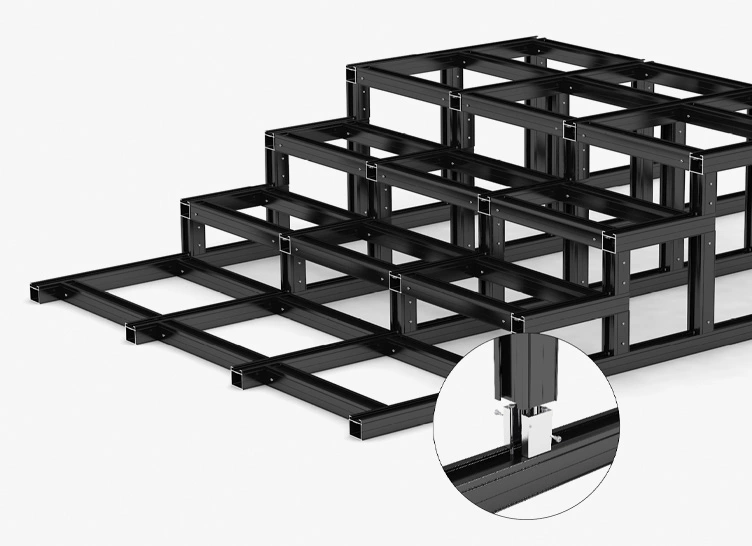
With the TRIAS system, attractive enclosures for above-ground pools can be erected in no time at all. Multi-levelling is the key here: the ingenious plug-in system can not only be assembled horizontally in any shape, but also offers the option of a three-dimensional supporting structure. So whether you’re looking for a whirlpool or jacuzzi to relax in, you can plan comfortable steps, platforms, decks and safe access points. Even where space is limited, this creates a brilliant solution. Space can also be quickly made for the necessary access hatches (for jets, massage systems, heating and control technology).
In-ground swimming pools are an excellent option for anyone looking for a durable, high-quality pool. As they are firmly anchored in the ground, in-ground pools are particularly stable and can be used all year round. Many models are fitted with high-quality components such as circulation pumps, sand filter systems or even integrated heating systems. These extras not only ensure clear water, but also make the pool usable during the transitional periods of spring and autumn. Whilst a freestanding pool can certainly be assembled yourself with a bit of DIY skill, you should always seek advice when installing an in-ground swimming pool and leave the work solely to a professional.
When buying an in-ground swimming pool, you can choose between pools that sit flush with the ground and those that protrude partially from the ground. You can also choose between round, oval and rectangular pools. Whichever you choose, the TRIAS ALU system offers you every possibility to integrate your dream pool perfectly into your patio landscape. The substructure with pedestal supports is uncompromisingly stable and offers maximum flexibility. This means you can combine decking boards and slabs as you wish with the TRIAS ALU base system and even replace them at a later date. The flexible construction principle offers great design freedom, including, for example, the option to extend the floor area of an existing terrace.
Do you need a suitable pool cover? Perhaps one that is both retractable and walk-on? The self-supporting aluminium profiles of the TRIAS system are also suitable for such special constructions! Simply send us your enquiry and we’ll be happy to get in touch with you.
Please note: In-ground swimming pools, particularly those with a great depth of water, require special safety measures, especially if children have access to the pool. To prevent accidents and ensure the safety of all bathers, it is important to ensure appropriate safety measures are in place.
Above-ground pools are primarily intended for temporary use. This means they must be stored away over the winter. They are generally easy to set up and relatively inexpensive. A distinction is made between frame pools, which have a frame made of metal tubes and a plastic liner, and wooden pools, which have sturdy wooden walls and a foil lining. Inflatable pools and the classic paddling pool are also quick solutions.
If above-ground pools are to be placed directly on the patio, they first require a load-bearing surface. The key factor is the load that will ultimately be borne by the patio. And with a well-filled pool, this can be quite substantial. The TRIAS ALU system is ideal for perfectly balancing additional point loads: depending on requirements, additional pedestal supports can be installed, thereby distributing the compressive load across several support points.
The question of structural integrity becomes all the more important when planning a (whirlpool) bath at a considerable height. What is the maximum permissible load in kilograms per square metre on the roof or roof terrace? This information is usually provided by the architect, a structural engineer or the property owner or landlord.
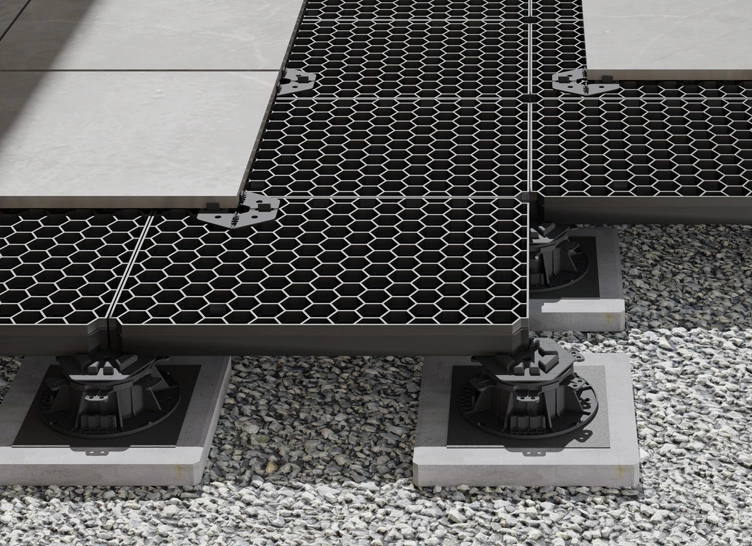
As a general rule, when planning flooring for roof terraces and balconies, the maximum point load on the substrate must be taken into account. This is where the TRIAS WABIC system comes into play: the unique honeycomb structure of the lightweight TRIAS WABIC panels significantly reduces weight whilst providing greater stability. Furthermore, the raised floor system offers effective protection against structural failure. So, should the load from the hot tub be too high, the raised floor substructure allows the load to be distributed over a larger area. This ensures maximum safety and looks good too.
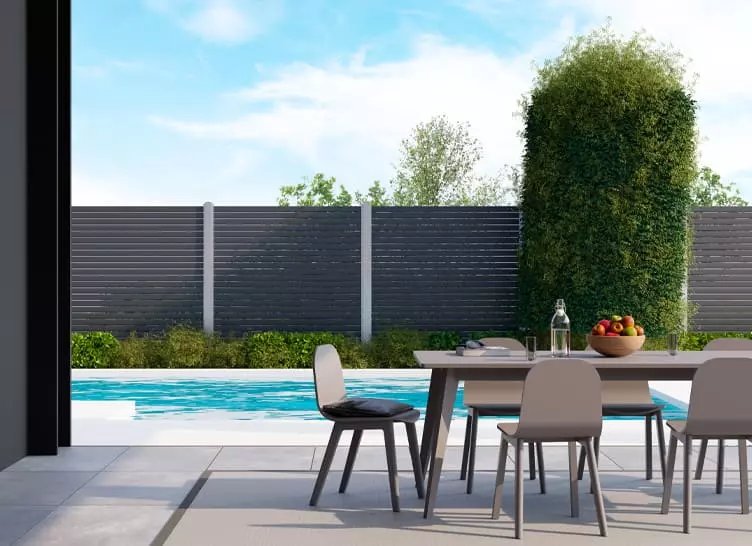
If you want to relax by the pool without being disturbed, you need plenty of privacy. The modular privacy screen from TRIAS is a good choice for shielding yourself from prying eyes. The system offers countless design options for front gardens, patios or pool areas. Thanks to its simple construction, a wide variety of materials – such as glass, wood, composite materials like WPC or metal – can be combined with this maintenance-free and durable system. This ensures the privacy screen suits any style and blends harmoniously into its surroundings. And it will last for many years: the entire structure is optimally protected against wear and tear and the elements.
The individual elements of this practical modular system can be used not only as privacy screens, but also as effective windbreaks and shade providers. The T-slots in the privacy screen posts allow the elements to be joined seamlessly at a 90-degree angle, i.e. around corners.
A well-planned pool terrace is more than just an aesthetic highlight – it is the key to long-lasting swimming enjoyment and comfort. The secret to success lies in the careful coordination of all components: from choosing the right substructure, which ensures stability and durability, to the harmonious integration of the pool, terrace and garden. Systems such as TRIAS ALU offer flexible and robust solutions that meet even the most demanding design requirements. Whether wood, natural stone or modern composite materials: choosing the right surface material and a well-thought-out design not only guarantee visual appeal, but also safety and functionality. This transforms your pool terrace into an oasis of relaxation and recuperation. Bring on the next summer!

