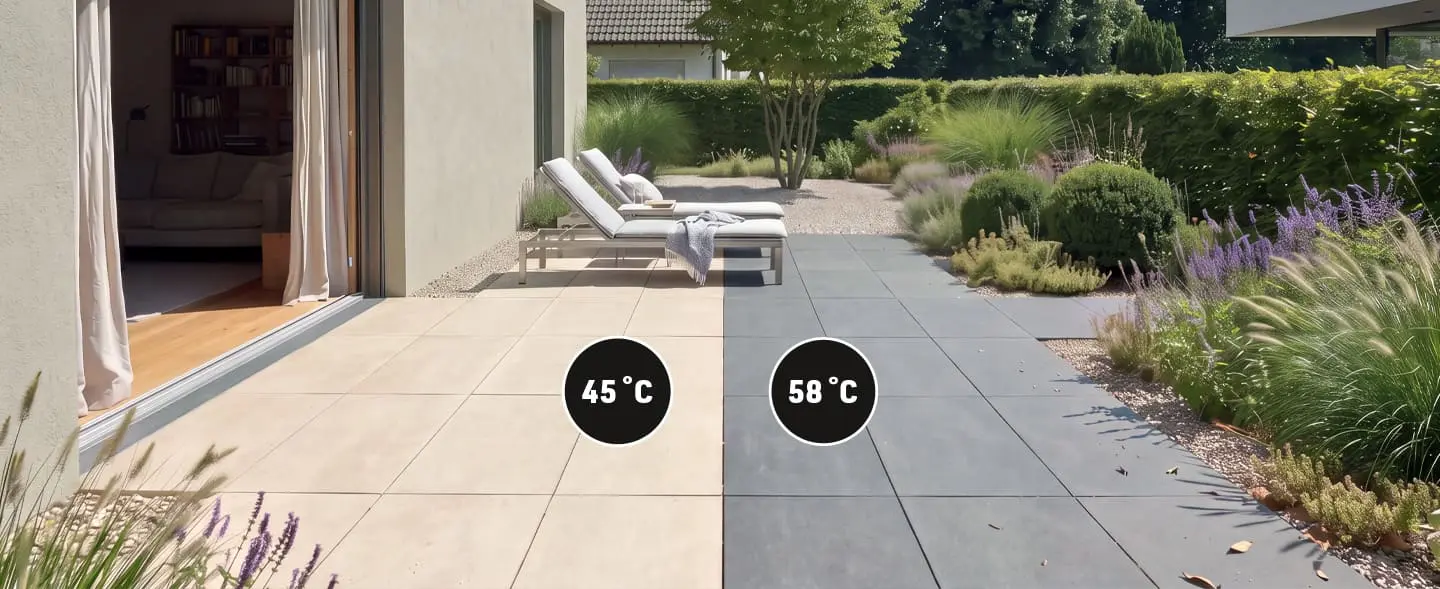
Heatwaves and prolonged periods of hot weather are becoming an increasingly common feature of summer in Germany too. This is noticeable not only in the garden but also on the patio: dark patio slabs in particular can become very hot in direct sunlight and quickly become uncomfortable to walk on barefoot. But how can you reduce the heat on your patio? We’ll show you what to look for when choosing patio slabs and which materials don’t heat up as much. We’ll also look at other cost-effective options and explain why the way your patio is constructed plays a role.
As a rule of thumb, light-coloured patio slabs heat up less in direct sunlight than dark ones. Choosing the right patio surface is therefore one of the most important decisions you’ll make when it comes to keeping your patio as pleasantly cool as possible in summer.
These light-coloured patio slabs heat up less:
- Porcelain stoneware slabs in beige, sand, cream or light grey shades
- Light-coloured natural stone, such as light granite, travertine or sandstone
- Light-coloured concrete slabs
In addition to colour, the following criteria also play a role:
- Heat storage capacity and heat release: Density and slab thickness influence how much heat a surface can absorb (store) and subsequently release. As clear manufacturer’s specifications regarding heat storage capacity are often lacking, we recommend obtaining sample slabs and laying them out at the intended location on the terrace. This allows you to measure and compare differences in surface temperature under real-world conditions yourself.
- Water absorption and evaporation: Depending on the type of stone, natural stone has a higher water absorption rate, whilst porcelain stoneware has a very low one (often below 0.5 per cent). However, during the current heatwaves, this effect plays a rather insignificant role due to the often low levels of rainfall.
How paving materials cool the terrace:
It is true that slabs can store a great deal of heat and release it again after sunset. Conversely, they can also absorb the cool night-time air and release it again during the day. However, this cooling effect is only noticeably effective if the terrace can be kept as cool as possible during the day. During summer heatwaves, this is often only possible on the north and east sides of the house. In direct, intense sunlight, however, the effect does not last long. East side of the house. In direct, intense sunlight, however, the effect does not last long.
When exposed to high temperatures, patio surfacing can expand and warp. A properly installed substructure can compensate for such movements. When laying the surfacing, always ensure that expansion joints are of sufficient size and follow the relevant manufacturer’s instructions. Wind and air movement can also have a significant impact on the thermal conditions on the terrace. In practical terms, this means that with sufficient air circulation, heat is less likely to build up on the decking, thereby reducing thermal expansion.
Another tip: with raised decking, heat can be dissipated into the surroundings via both the top and underside of the slabs. If you wish to install thin slabs (as they store less heat), TRIAS WABIC 2.0 is a good choice. TRIAS WABIC 2.0 enables puncture-proof installation on the system’s load-bearing grid structure – perfect for thinner slab coverings. Please always follow the relevant specifications provided by the respective slab manufacturer.
Innovative TRIAS systems offer well-designed solutions for installing slab flooring in a wide range of formats and materials. Weather-resistant aluminium substructures such as TRIAS ALU combine durability with high stability and flexible design options. They are often more cost-effective than one might think. Tiles can be laid freely on a raised floor system such as TRIAS WABIC 2.0. With TRIAS CROSS, the tiles are laid directly onto TRIAS HELIX pedestals.
Here is an overview of the key TRIAS systems:
All systems are suitable for slab flooring and are used on patios, balconies and roof terraces. They differ in their construction and in the laying patterns and loads they can accommodate.
Sometimes it only becomes apparent after a few hot summers that the choice of patio surfacing wasn’t ideal. A very dark surface can quickly become uncomfortable in a location that is already warm and sunny. However, anyone who opted for a dark option when originally designing their patio doesn’t have to put up with it permanently.
On many substructures, the slabs are laid loosely. A clear advantage is that the paving can be lifted and replaced relatively easily if necessary. This offers greater flexibility than permanently grouted paving and is completed much more quickly.
Important when replacing the decking: the new slabs should have exactly the same dimensions as the old decking. Dimensions can vary slightly from one manufacturer to another. It is essential to take this into account when selecting the new decking so that the existing substructure can continue to be used.
The TRIAS Terrace Planner makes it easy to work out how many slabs are needed for the area.
Is it worth replacing the decking?
Generally speaking, yes. Choosing a suitable, lighter-coloured decking can noticeably reduce the heat build-up on the terrace. A cool surface is always the most sustainable solution and therefore a comparatively cost-effective choice. Instead of an expensive pergola, sun sails or awnings, for example, are sufficient for creating cool, shaded areas.
What other cost-effective ways are there to keep your patio cool? Good air
circulation works wonders, and a cooling breeze is free. So always ensure there’s good ventilation on your patio. Our tip: Partially open privacy screens offer protection and privacy whilst still allowing plenty of air to pass through.
A light-coloured, suitable patio surface helps to significantly reduce heat build-up on hot summer days. Sun protection and good air circulation also help to keep the patio pleasantly cool. However, if you already have a surface that is too dark or unsuitable, you don’t need to rebuild the entire patio: on many substructures, loose-laid slabs can be replaced relatively easily. This saves time and effort.


