Es gibt keine nationalen oder internationalen Normen. Bodenfliesen haben häufig eine Stärke 10, 12 oder 20 mm. Je stärker desto belastbarer aber auch schwerer ist die Fliese. Im Outdoor-Bereich werden Platten mit 20 mm Stärke bevorzugt. Auch stärkere Platten (30 mm und mehr) können verwendet werden, beispielsweise für die direkte Verlegung auf Stelzlagern oder Kiesbett. Generell empfiehlt sich ein Durchbruchschutz wie TRIAS WABIC, insbesondere für dünnere Varianten.
The best paving slabs for the patio
Anyone looking for suitable flooring materials in shops will be faced with a wide range of options and terms. We have compiled a list of the most important types of flooring materials, along with their advantages and disadvantages, here.
What types of paving slabs are available for the patio?
Essentially, there are three types of paving: porcelain stoneware tiles, natural stone and concrete patio slabs. Each material has its own distinctive look and specific properties. As well as the appearance, when choosing the right flooring, you should consider the care and maintenance required. After all, this remains an ongoing consideration for years to come and must be carried out. Patios are exposed to extreme weather conditions, and the strain on both the flooring material and the substructure is considerable.
Porcelain stoneware: attractive and easy to look after
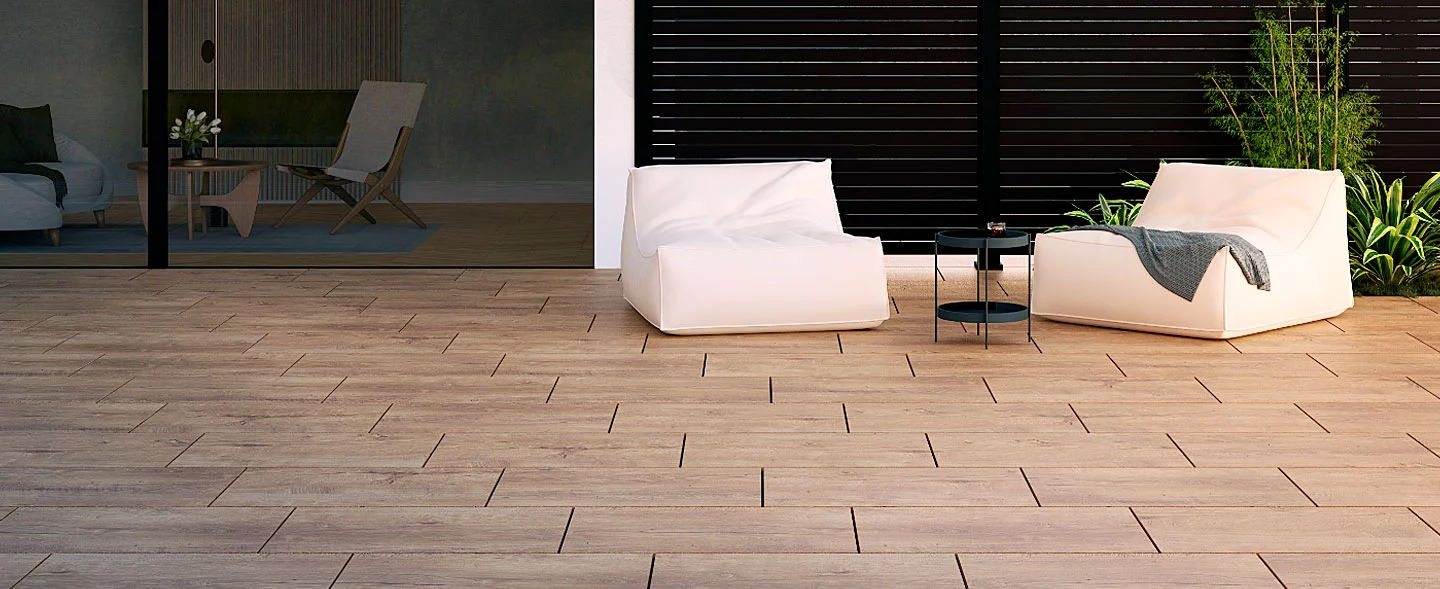
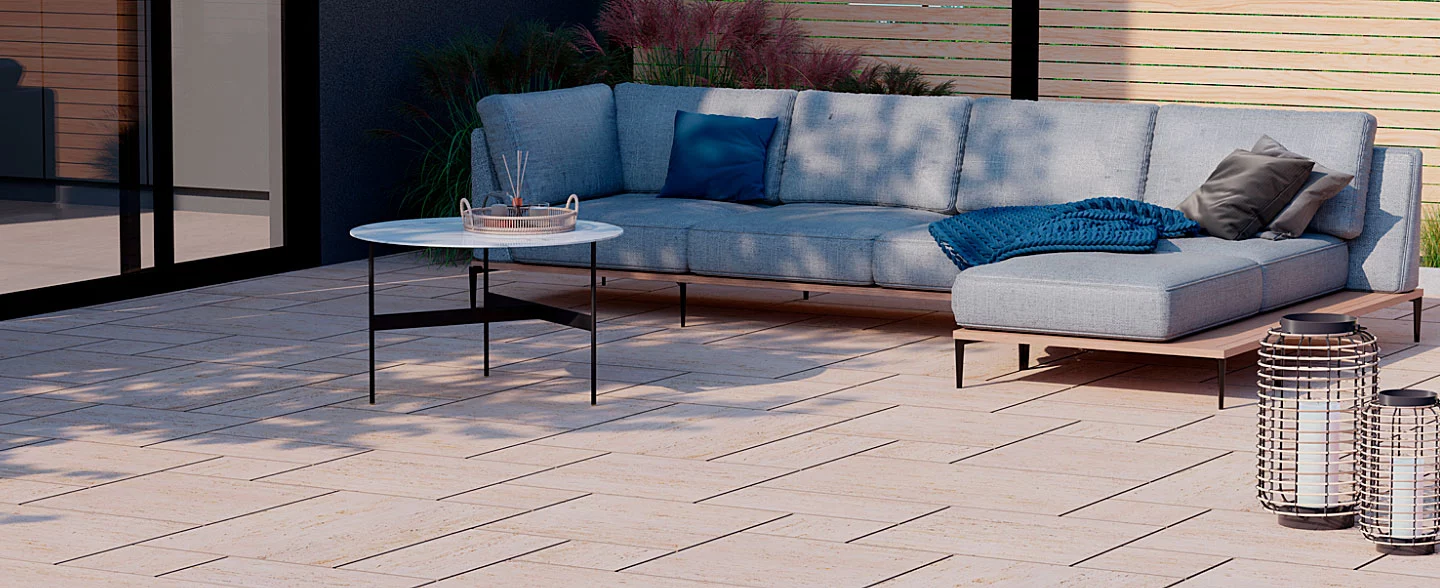
Outdoor porcelain stoneware slabs fall into the category of ceramic tiles; they are robust, easy to maintain and available in a wide range of designs. They are currently among the most popular and attractive flooring options for patios. The latest trend is wood-effect tiles. Many delicate materials are replicated in the form of hard-wearing porcelain stoneware, such as slate.
What is porcelain stoneware?
Porcelain stoneware refers to industrially manufactured tiles that are formed under high pressure and fired at temperatures of up to 1,300 degrees. The raw materials used are quartz, kaolin, feldspar and clay. Although the term ‘porcelain stoneware’ (also known as ‘Böttger stoneware’ in specialist circles) is used in EN 14411, it is not clearly defined. It is therefore regarded as a so-called trade name.
What are the advantages of porcelain stoneware?
Porcelain stoneware is easy to clean and requires virtually no maintenance. It is resistant to cleaning products. The colours are UV-stable and do not fade when exposed to sunlight. Porcelain stoneware has no open pores and is virtually waterproof. Its density is almost as high as that of glass. The material therefore absorbs virtually no water (less than 0.5 per cent). This is a major advantage, as water penetration can cause damage in freezing conditions. The non-porous surface prevents mould and moss from adhering. The wide range of colours, sizes and textures is unbeatable.
What are the disadvantages of porcelain stoneware?
Porcelain stoneware feels just as hard as tiles when you walk on it. It feels slightly cooler than natural stone. Dark tiles can become very hot in summer. As the material is relatively thin, it hardly dissipates the heat and retains it for a long time. Water can pool on the waterproof surface and freeze, creating a risk of slipping. Special finishes help to counteract this.
What are the differences between various types of porcelain stoneware?
Porcelain stoneware tiles are available in solid-coloured, glazed and unglazed finishes, as well as in numerous other variants. The term ‘full-body’ refers to a tile made entirely of porcelain stoneware. However, to keep costs down, tiles are often constructed in layers: the high-quality porcelain stoneware surface is combined with a cheaper backing material. Textures on the surface can be created using digital printing techniques or sand glaze.
Are the formats standardised?
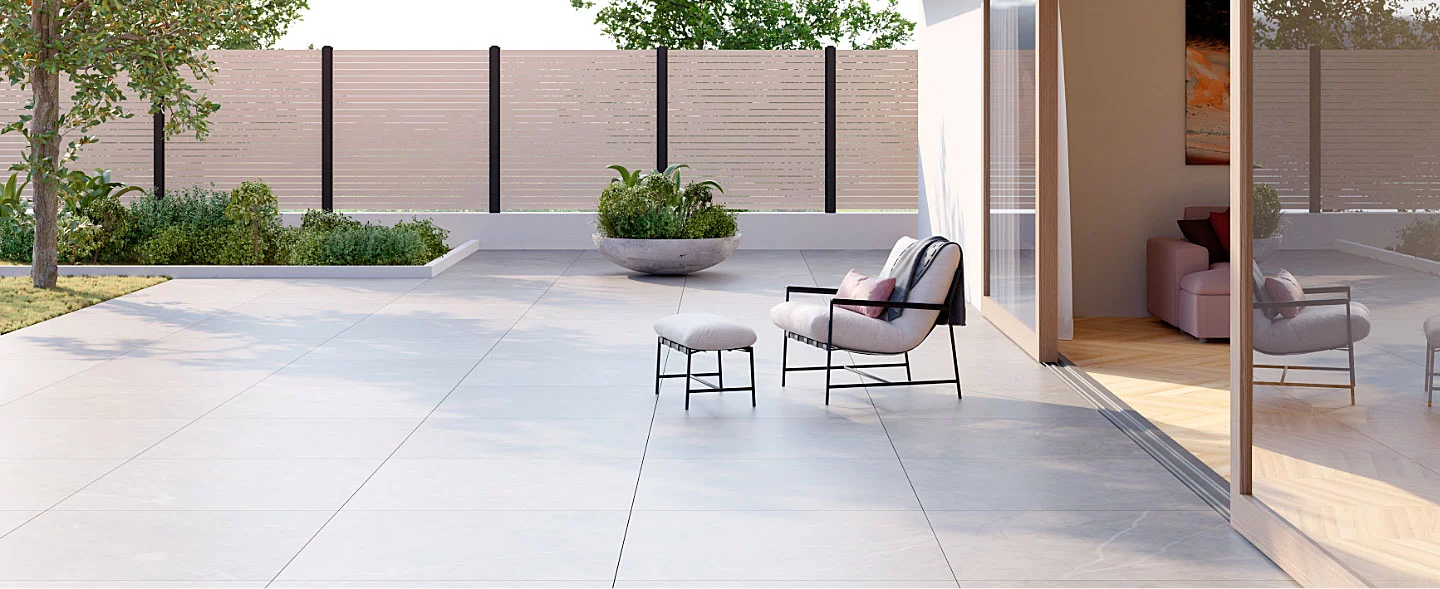
No, there are no fixed standards for tile sizes. Common sizes include 40x60 and 60x60 cm. Larger sizes are also available: 60x120 cm, 45x90 cm and even 120x240. With the trend towards wood-effect tiles, narrow, plank-like sizes are becoming increasingly popular. For use in the TRIAS SICHTSCHUTZ system, we recommend tiles in the sizes 60x60, 90x90, 120x60 and 120x30.
What kind of substrate should be used for porcelain stoneware tiles?
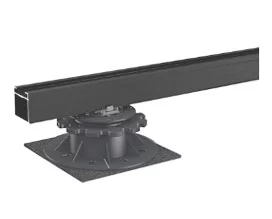
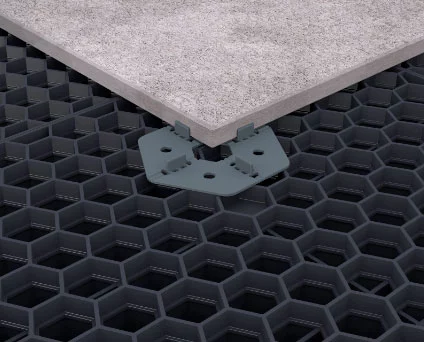
Porcelain stoneware tiles can be laid directly on pedestal supports or on the TRIAS WABIC or TRIAS ALU systems. The MULTICLIP system ensures a uniform joint width when using the TRIAS ALU system. The tiles must be of the same size. For different tile sizes and variable laying patterns, a raised floor system comprising grid elements is more suitable. The TRIAS WABIC system also offers effective fall-through protection. The boards of the TRIAS WABIC system can also be combined with the aluminium profiles of the TRIAS ALU system. This ensures maximum stability.
Natural stone slabs: naturally beautiful
Natural stone comes in a fascinating variety. As a natural material, it exudes a special sense of tranquillity and offers a unique ‘feel underfoot’. No two slabs are alike. Some materials, such as travertine, captivated the Romans and were also used by Mies van der Rohe for the Barcelona Pavilion. Other types of stone have shaped the character of entire cultural eras. Marble is virtually synonymous with Baroque architecture and is currently enjoying a minimalist revival. Natural stone is a commitment to clarity and the authenticity of the material. It is not always the most practical material, but it always makes a statement.
What is natural stone?
The term ‘natural stone’ refers to all types of rock that have formed naturally. Their appearance has been shaped by geological processes. Natural stone has been used as a building material since ancient times. For patio flooring, natural stone is cut into slabs.
What are the advantages of natural stone?
Terraces made of natural stone offer an unrivalled, natural feel underfoot and a high-quality, unique appearance. They blend seamlessly into the garden setting. The combination with blocks, which can be used as steps, is particularly attractive. By its very nature, stone is very durable, weather-resistant and UV-resistant. Even with signs of wear, natural stone still looks beautiful. If necessary, the surface can be sanded down, meaning that no slabs need to be replaced.
What are the disadvantages of natural stone?
The surface of natural stone is porous and can therefore become soiled. This can be prevented by applying a sealant. Cleaning it is more labour-intensive than with tiles. It is also slightly more expensive than porcelain stoneware or concrete.
What types of natural stone are available for patios?
Natural stone slabs for patios are available in slate, limestone, gneiss, basalt, granite, marble, porphyry, sandstone, bluestone and travertine. The name of the stone refers to its mineral composition. Colour variations are possible within each type of natural stone. Please note: Every piece of natural stone is unique. Colour variations may occur with repeat orders.
How delicate is natural stone?
Sensitivity depends on the type of rock. Hard rocks such as basalt and granite are considered highly durable (the latter is therefore used for paving stones subject to heavy wear and tear). Sandstone and marble require a little more care and attention. Most types of stone have high compressive strength. Natural stone is regarded as one of the most stable building materials after steel.
Is natural stone environmentally friendly?
As with any mineral building material, the quarrying of natural stone also has an impact on the environment. In the case of locally sourced stone, shorter transport distances mean lower transport costs compared with imported materials. In Germany alone, there are over 200 quarries where granite, basalt, sandstone, limestone, dolomite, slate and other types of rock are quarried. Like many natural materials, natural stone is ‘patina-prone’ – signs of wear and tear make it even more beautiful. Untreated natural stone can also be recycled and reused following demolition.
What sort of substructure should be used for natural stone terraces?
Due to their heavy weight, wooden substructures are not particularly suitable. Wood can also rot, in which case it no longer provides a secure base. Natural stone can be laid directly onto a bed of gravel or mortar. We recommend a sturdy aluminium substructure and TRIAS WABIC as anti-break-in protection.
Concrete slabs: a building material of the modern era
Concrete was long regarded as a rather unattractive material, but has long since evolved from a rough, industrial look to a sophisticated aesthetic. Exposed concrete has a simple, contemporary and minimalist appearance. Its versatile applications speak for themselves. A concrete-look terrace is the perfect complement to a house with a clean-lined Bauhaus style. Large formats and crisp cross-joints create a spectacular and spacious effect.
What are concrete slabs made of?
Concrete is made from cement, water and aggregate (gravel or sand). It is mixed into a paste and subsequently hardens. The raw materials used in concrete are predominantly of natural origin.
What options are available?
Concrete can take on almost any shape. Concrete slabs are therefore available in a wide variety of colours, surface textures and patterns; surfaces can be polished or left rough, as desired. Even colour gradients are possible. Combinations with coarse gravel, giving a retro feel, are particularly appealing. When left unpolished, this variant is known as a ‘washbasin concrete slab’. Polishing creates interesting effects. Untreated concrete slabs are quite delicate. The surface is therefore usually sealed, a process that must be repeated to prevent signs of wear. Concrete slabs are available from 12–15 euros per square metre. Coloured (dark) varieties are significantly more expensive, particularly if they have also been ground, polished or sealed. Concrete is available in numerous varieties and colour shades. Some surfaces even resemble ceramic tiles with a matt sheen.
What sort of sub-base should be used for concrete patio tiles?
Concrete slabs are a classic choice for patio flooring – and they’re literally quite heavy. A slab in a typical size, such as 50 x 50, weighs just under 30 kg. The reason for this is their thickness: concrete slabs are usually at least 5 cm thick. Suitable substrates include drainage mortar, a loose gravel bed or pedestal supports. Due to their weight, particular attention must be paid to the stability of the substructure.
Mixing panels and floorboards?
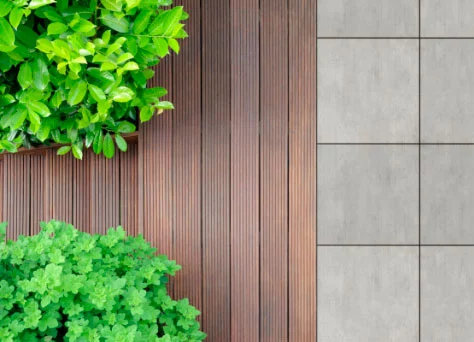
That is possible. The Multiclip system of the TRIAS ALU substructure can accommodate both floorboards and sheet flooring. It is important to adjust the height accordingly. By changing the floor covering, you can define different zones and adapt the flooring to the specific requirements of each area, for example, a fire-resistant area around an outdoor kitchen.
Better with anti-break-in protection?
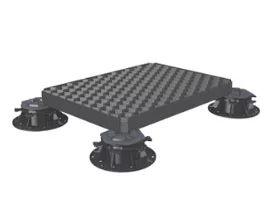
The TRIAS WABIC system offers effective protection against break-throughs. Panels of a wide variety of sizes can be freely positioned on the uniform base surface made up of grid elements. The system’s X-Pads (installation crosses) can be positioned as required and allow for a wide variety of installation patterns.
View the installation system
Welche Stärke haben Feinsteinzeugfliesen?


Was ist Feinsteinzeug für ein Material?
Unter Feinsteinzeug versteht man industriell hergestellte, keramische Fliesen die unter hohem Druck geformt und bei bis zu 1300 Grad gebrannt werden. Verwendet werden Rohstoffen, wie z.B. Quarz, Kaolin, Feldspat oder Ton. Die Dichte ist fast so hoch wie bei Glas.
Was versteht man unter einer Fliese?
Eine Fliese ist perse ein zumeist quadratischer oder rechteckiger flacher Belag der die Widerstandsfähigkeit für Böden, Dächer, Wände etc. verbessern soll. Als Material ist Naturstein, sogar Glas, Keramik, Steingut, Metall oder gebrannter Ton denkbar. Aktuell sind achteckige Fliesen modern.
Ist Feinsteinzeug ein Naturstein?
Nein, Naturstein ist, wie der Name schon sagt, ein natürlich entstandener Stein. Feinsteinzeug wird industriell hergestellt. Die Rohstoffe werden unter Druck geformt und gebrannt.
Ist Feinsteinzeug wasserdicht?
Die Wasseraufnahme bei Feinsteinzeug liegt unter 0,5%. Das Material gilt als wasserdicht und ist daher besonders frostsicher. Auch deswegen ist Feinsteinzeig für Terrassen besonders beliebt. Je nach Hersteller können die Eigenschaften variieren.
Was ist der Unterschied zwischen Fliesen und Feinsteinzeug?
Als Fliese wird ganz allgemein ein flacher, plattenartiger Belag für Boden, Wände etc. bezeichnet. der Begriff „Feinsteinzeug“ ist, ebenso wie Glas, ein Materialangabe. Platten aus Feinsteinzeug zählen zu den keramische Fliesen (wie auch Grobkeramik „Terracotta“). Feinsteinzeug wird gepresst, unter hohen Temperaturen gebrannt und ist sehr dicht.
Was ist härter Granit oder Feinsteinzeug?
Für Feinsteinzeug beträgt die Mohs-Härte 7-9, für Granit 6-7. Je nach Hersteller und Variante können die Eigenschaften also variieren. Unter Härte versteht man den mechanischen Widerstand eines Materials gegen mechanisches Eindringen. Für Terrassen ist die Abbrieb- oder Kratzfestigkeit von Belang. Die Härte eines Materials kann nach der Mohs-Skala angegeben werden (Ordnungsskala 1 bis 10), einem Prüfverfahren, dass die Kratzfestigkeit ermittelt (auch Mohs-Härte, Ritzhärte). Diamanten gelten mit dem Wert 10 als härtestes Material.
Was versteht man unter Ritzhärte?
Unter Ritzhärte versteht man die Widerstandfähigkeit gegen Kratzer. Als Bewertungssystem dient in den DIN- und EURO-Normen die Mohs-Skala (benannt nach dem Mineralogen Friedrich Mohs 1773-1839). Diese Skala reicht von 1-10. Mit dem Wert 10 wird der Diamant das härtestes Material eingestuft. Für Bäder gilt der Wert 3 als ausreichend für eine leichte Beanspruchung, der Wert 5 genügt starker Beanspruchung. Im Wohnbereich wird bei starker Beanspruchung zu einem Material mit der Mohs-Härte 7 geraten. Die Angabe der Mohs-Härte hat sich im Handel noch nicht durchgesetzt.
Kann man Marmor für Terrassen verwenden?
Ja, Marmor lässt sich für Terrassenböden verwenden. Marmor gehört zur Kategorie der Natursteinplatten. Besonders beliebt ist grau-blauer Afyon Marmor, der an belgischen Granit erinnert. Etwas heller ist türkischer Marmor. Marmor ist frostsicher, zählt jedoch zu den eher weicheren Steinen. Diese Eigenschaft macht ihn angenehm begehbar erfordert aber etwas Rücksicht bei der Nutzung. Ein absolutes Tabu für Marmorböden sind: Streusalz, Hochdruckreiniger und alle Säuren, da Marmor zu einem hohen Anteil aus Kalk besteht.
Welcher Naturstein ist für den Außenbereich geeignet?
Zu den widerstandsfähigsten Natursteinen für Außenbereiche zählen Granit und Basalt. Beliebt sind Sandstein und Travertin. Die meisten Natursteine kommen mit Wind uns Wetter gut zurecht. Bei porösen Materialien kann Wasser zu Schäden führen.
Was sind kalibrierte und rektifizierte Fliesen?
Darunter versteht man Fliesen mit begradigten Rändern. Die Rektifizierung (bzw. Kalibrierung) ist ein zusätzlicher Bearbeitungsschritt bei dem die Fliese einen Rand von 90 Grad erhält. Das Verlegemuster wirkt so exakter. Bei Natursteinen macht ein unebener Rand allerdings gerade den Charme des natürlichen Materials aus und ist daher erwünscht.
Brauchen rauhe Terrassenböden mehr Gefälle?
Ja, damit Wasser besser abfließen kann. In rauhen, offenporigen Materialien kann sich Wasser sammeln, einsickern und den Belag schädigen. Bei Frost kommt es zur Ausdehnung des eingesickerten Wassers und möglicherweise zu weiteren Schäden. Natursteinböden sind besonders betroffen. Es empfiehlt sich ein Gefälle von 3% und mehr für Natursteinböden im Gegensatz zu 2 bis 2,5% für Beton- und Feinsteinzeugböden.
Sind Schieferplatten für Terrassen geeignet?
Ja, Schiefer kann sehr gut für Terrassen verarbeitet werden. Schiefer ist ein Sammelbegriff für verwitterungsbeständiges, spaltbares Gestein und zählt zu den Natursteinen. Die Farbe varriert von hellem bis sehr dunklem Grau, es gibt auch rostfarbene Varianten. Als Terrasse wirken dunkle Böden (ebenso wie im Bad) sehr edel. In exponierten Sonnenlagen auf Südseiten können sich dunkle Böden allerdings stark erhitzen. Eine zugige Dachterrasse kann von der guten Wärmespeicherfähigkeit des Materials profitieren. Schiefer wird in Brasilien, China, Indien aber auch in Norwegen und Deutschland abgebaut. Charakteristisch ist die typische, naturgespaltene Schieferoberfläche mit ihrer taktilen Qualität.

