
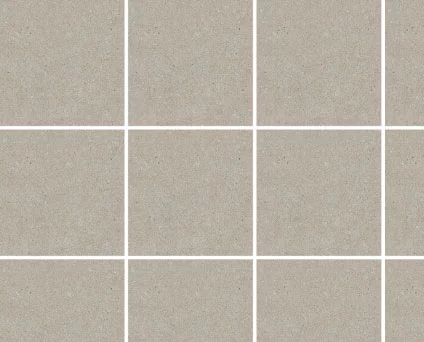
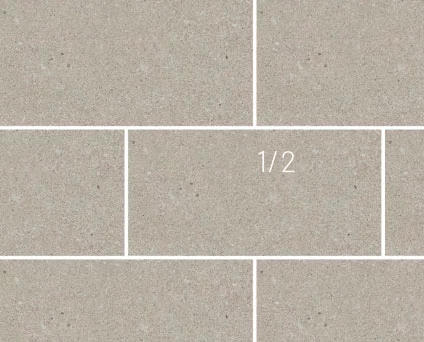
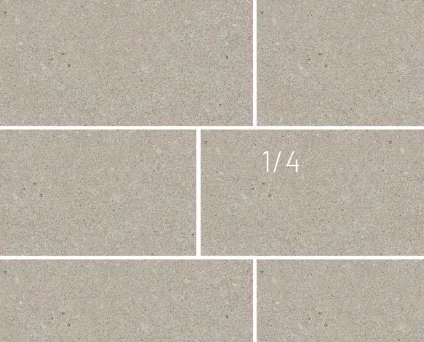
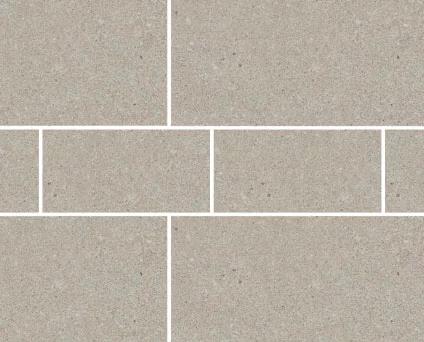
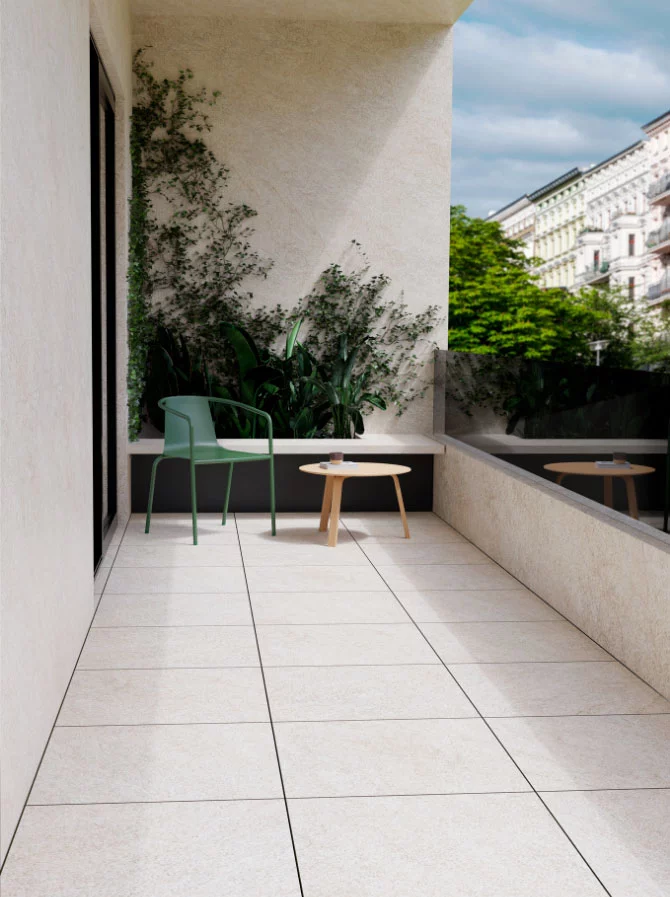
Ja, der Kreuzverband kann auch für Fliesen 30x60 genutzt werden. Grundsätzlich sind alle Formate möglich, also auch 60x60 oder 120 cm Länge. Sowohl quadratische als auch rechteckige Formate sind geeignet. Grundsätzlich wirkt dieser Verband immer sehr klar und minimalistisch. Je größer die Formate, desto ruhiger wirkt die Fläche.
The most attractive laying patterns for patio slabs
Choosing the right laying method is just as important as selecting the right material. The right combination of material and laying method gives your patio its unique look. We showcase the most attractive laying patterns for paving slabs here. Even the most varied sizes can be combined.
What should be taken into account when choosing a laying pattern?
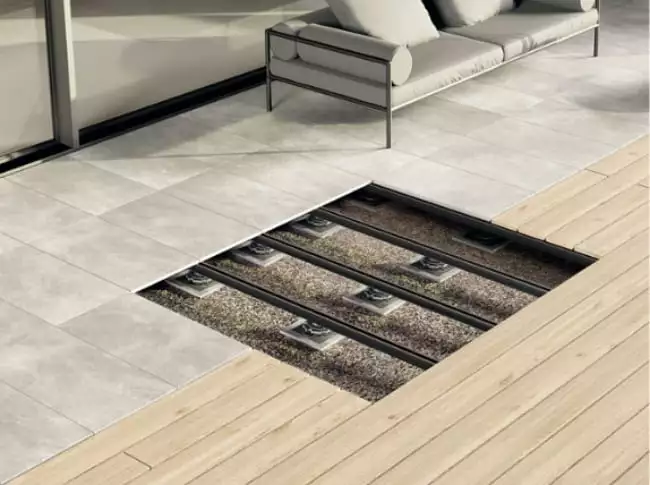
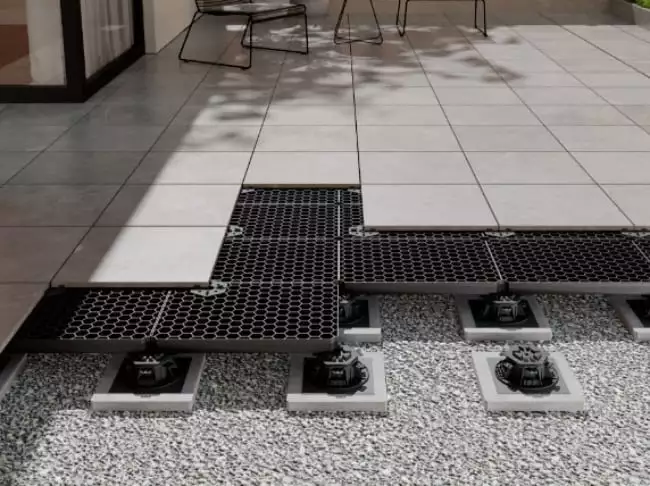
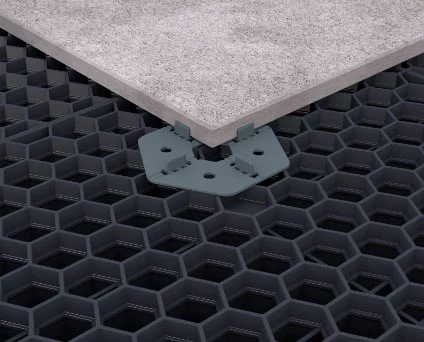
When choosing a laying method, you should ensure that it suits the architectural style, the size of the terrace and the character of the material. Very large formats call for understated layouts, such as the cross-joint pattern. Unconventional patterns need space to come into their own. Furthermore, not every substructure is suitable for all laying methods. When laying on pedestals, your choice of slab sizes and layout is very limited, as the slabs are usually supported only at the corners. Trias Wabic offers you maximum design freedom. These sturdy boards provide an even surface for tile flooring. Thanks to the flexibly positionable X-Pads (installation crosses), tiles can be laid freely across this surface. Your tiles are also protected against breakage.
Sie haben Fragen zur Planung Ihrer Terrasse?
Cross-joint: Maximum clarity
With this laying method, tiles are laid flush against one another. The joints thus form uniform crosses. All tiles are the same size. Both square and rectangular formats are possible, though square formats are most commonly laid in a cross-joint pattern. This laying method has a minimalist, clean look, but can also appear rather cold and functional. The larger the tile formats, the more striking this clean arrangement appears.
What is meant by ‘laying in a pattern’?
In what is known as a staggered layout, the slabs are laid in a staggered pattern. The offset may be regular or irregular. The joints run in a sort of staircase pattern rather than in a straight, continuous line, as with the cross-joint layout. A distinction is made between half, quarter and third-tile patterns, or the term ‘random’ pattern (also known as a ‘strip’ pattern) is used when no regularity is apparent. Special patterns are created by the ‘Roman bond’, which comes in numerous variations. In this method, fixed groups of different sizes are arranged and fitted together like a jigsaw puzzle.
Half-bandage: popular and versatile
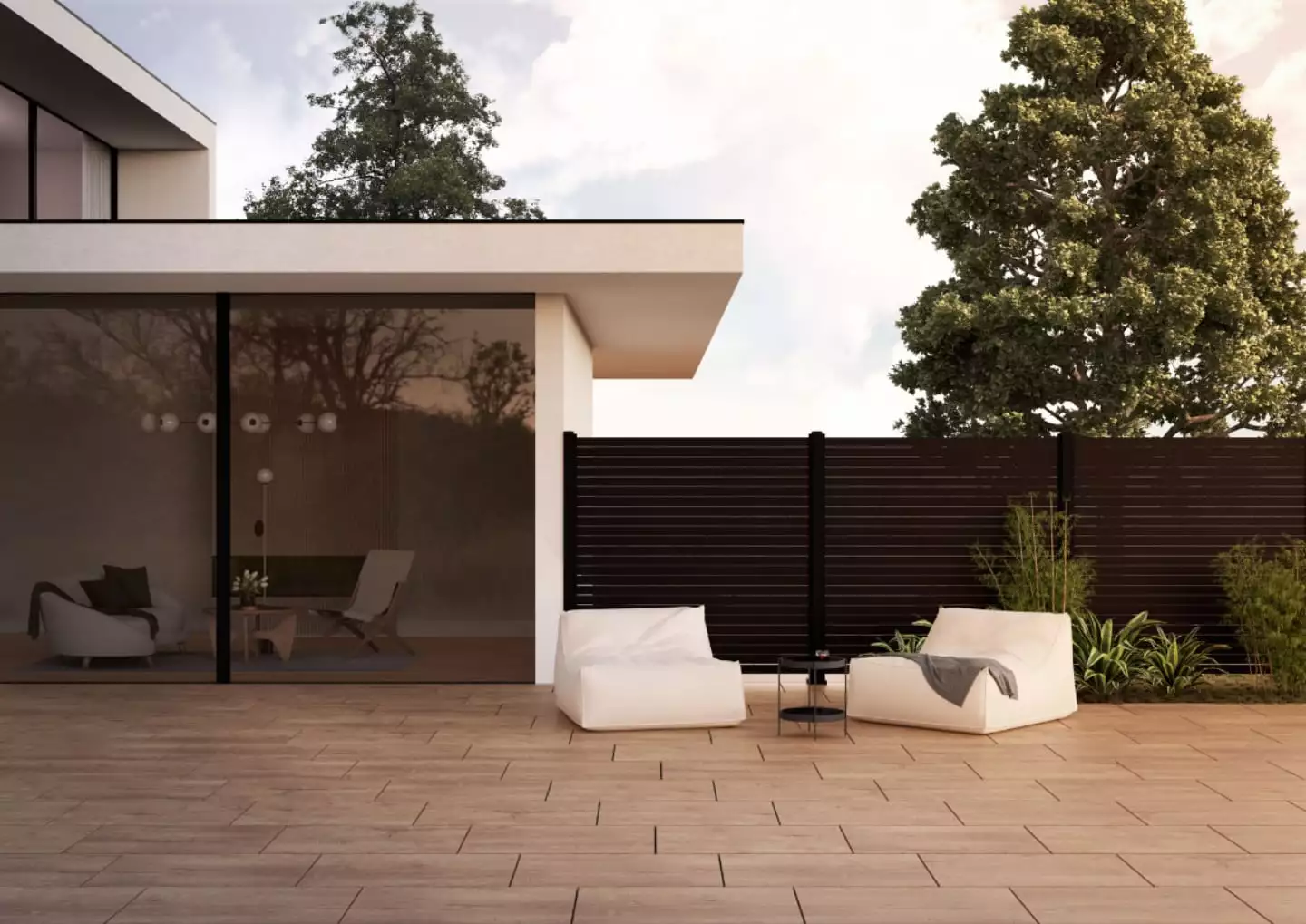
In a half-bond (also known as a ‘half-offset’ or ‘English pattern’), the next row of tiles is positioned exactly at the centre (or ‘half’) of the adjacent tile (in the case of the third-way pattern, correspondingly at one-third of the tile, and so on). Wood-effect tiles look very uneven when laid in a half-stretch pattern. Generally, uniformly sized, rectangular formats are suitable. Please note: Very large, elongated tiles are often slightly warped. This can be particularly noticeable when laid in a half-stacked pattern. Therefore, the maximum size should be 30 x 60 cm. (Sub-structure: Trias Alu and/or Trias Wabic)
Quarter-plate: Stimulates the soil
The next row of tiles is offset by a quarter of the width of the previous row. This laying pattern creates a softer and more natural look than the half-bond pattern with its typical brickwork appearance. The quarter-bond pattern can be used to make surfaces appear longer. Rectangular formats of uniform size are generally suitable. The quarter-bond pattern requires precise laying to achieve a regular appearance. (Sub-structure: Trias Alu and/or Trias Wabic)
Railway Association: A change of décor
To achieve this, strips of varying widths are laid side by side. The length of the tiles within a strip may vary, but does not have to. Floors laid in a strip pattern have a Mediterranean yet modern look. To ensure the overall effect is not too busy, the strip widths should be repeated at regular intervals and only a few different sizes should be used. (Underlay: Trias Alu and/or Trias Wabic)
Diagonal binding: Thinking in angles
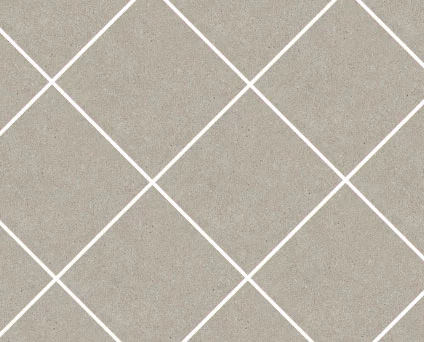
For a diagonal pattern, tiles are usually rotated at an angle of 45 degrees. This laying method looks particularly attractive with classic terracotta tiles or natural stone. The tiles for the edges must be cut to the correct angle. Consequently, there is a significant amount of waste. Material consumption may increase by 10 per cent or more. Square tiles are often laid diagonally. Diagonal laying is suitable for entire surfaces or for partial installations to create focal points. (Substructure: Trias Wabic)
Roman Association: Ancient charm with a modern twist
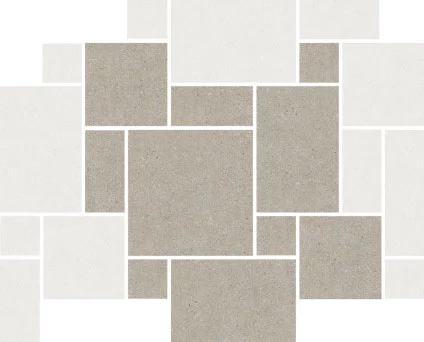
It is regarded as the fine art of tiling and draws on ancient models. A typical feature is the pattern, which appears to be purely random. The floor covering consists of regularly repeating, identical groups of tiles in different formats. The centre of such a group is often a square. There are numerous variations. Many tile manufacturers already offer pre-assembled group units. This laying method looks particularly attractive with natural stone, such as classic travertine. (Sub-base: Trias Wabic)
Herringbone pattern: A stylish reference
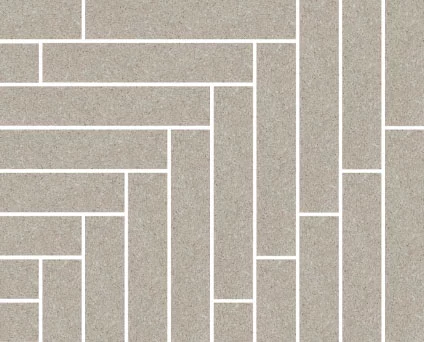
The herringbone pattern pays homage to the elegant parquet floors of historic villas. It is timelessly modern and makes for an unusual highlight as a terrace or balcony floor. To create the characteristic pattern, narrow rectangles are laid out in a V-shape. Narrow rectangles of the same size are suitable. The edges of the terrace are slightly more labour-intensive to lay, as the slabs must be cut to the correct angle. Precise work is also required across the entire surface. (Substructure: Trias Wabic combined with Trias Alu)
Herringbone pattern: a classic with charm
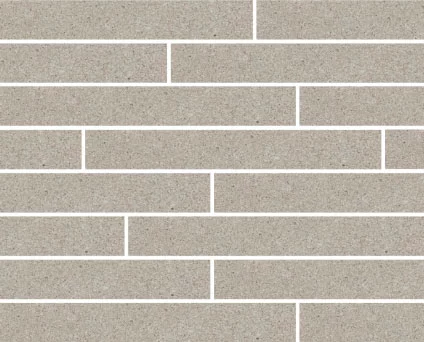
The ship deck pattern is a simple laying method familiar from plain wooden floors. The pattern consists of elongated planks laid end-to-end without any discernible regular offset. It is also referred to as a ‘random pattern’. Please note: To ensure the floor looks uniform, the gap between the planks must be at least as wide as one plank. Two transverse joints that are too close together look unsightly. The ship deck pattern is suitable for long, plank-like formats and goes well with wood-effect tiles. (Sub-base: Trias Wabic combined with Trias Alu)
TRIAS WABIC
The Trias Wabic decking substructure offers effective fall-through protection for decking with slab paving. The system allows for creative laying patterns. This is made possible by the ‘X-Pad’ laying crosses, which can be positioned freely across the surface.
View the installation system
TRIAS WABIC: Perfect for attractive tiled surfaces
Tiles of a wide variety of sizes can be laid freely on the uniform base surface made up of grid elements. The system’s X-Pads (laying crosses) can be positioned as required and allow for a wide variety of laying patterns. A range of joint widths is available.
Eignen sich Fliesen 30 x 60 für den Kreuzverband?


Warum sollte man Fliesen nicht im Halbverband verlegen?
Lange Formate sind nicht unbedingt für den Halbverband geeignet. Der Grund: Durch den Brennvorgang kommt es zu leichten Unregelmäßigkeiten und Verformungen, die bei diesem Verband besonders auffallen.
Was versteht man unter einer losen Verlegung?
Bei der losen Verlegung wird weder Mörtel noch Kleber verwendet. Die lose Verlegung hat große Vorteile: Unebenheiten lassen sich einfacher ausgleichen und Fehler nachträglich korrigieren. Defekte Platten können einfach ausgetauscht werden.
Welche Unterkonstruktion für Steinterrassen?
Wegen des hohen Gewichtes sind Unterkonstruktionen aus Holz nicht besonders geeignet. Holz kann außerdem verrotten und bietet dann keine sichere Auflage. Naturstein lässt sich direkt auf einem Kies- oder Mörtelbett verlegen. Wir raten zu einer stabilen Unterkonstruktion aus Aluminium und TRIAS WABIC als Durchbruchschutz.
Was sind Polygonalplatten?
Dieses Verlegeart war in den 70ern besonders beliebt. Dabei handelt es sich um Naturtsteinplatten mit unterschiedlichsten Formaten und natürlichen wirkenden, unregelmäßigen Bruchkanten. Verlegt wird lose in Sand oder Splitt oder auch in Mörtelbett (gebunden). Als Untergrund sind Beton oder ein Kiesbett geeignet. Für das Verlegen auf Stelzlagern oder auf einem Doppelbodensystem ist diese Verlegeart nicht möglich. Noch etwas ist zu beachten: Böden aus Polygonalplatten sind oft etwas uneben. Stühle und Tische können kippeln. Als Gartenweg macht sich diese Verlegeart dagegen besonders schön. Attraktiv ist die Kombination einer planen Terrasse mit natürlich wirkenden Gartenwegen aus Polygonalplatten.
Besser große oder kleine Fliesen?
Wer seine Terrasse größer wirken lassen will sollte sich für große Fliesen entscheiden. Noch ein Trick: Insbesondere helle Farben „vergrößern“ die Terrasse optisch. Große Fliesen sind auf Grund des Gewichtes allerdings schwieriger zu verarbeiten. Das Zuschneiden großer Formate erfordert Erfahrung. Ungenauigkeiten (wie ungleichmäßige Fugen etc.) werden außerdem schnell sichtbar. Kleinere Fliesen lassen sich dagegen einfacher an besondere Begebenheiten wie beispielsweise unebene Terrassenränder anpassen. Zudem ermöglichen sie viele kreative Verlegemuster und damit individuelle Gestaltungsmöglichkeiten. Mit TRIAS WABIC können unterschiedlichste Formate verlegt und sogar miteinander kombiniert werden. Generell gilt: Das Format sollte in einem Verhältnis zur Terrasse stehen und zum Stil des Gebäudes passen.

