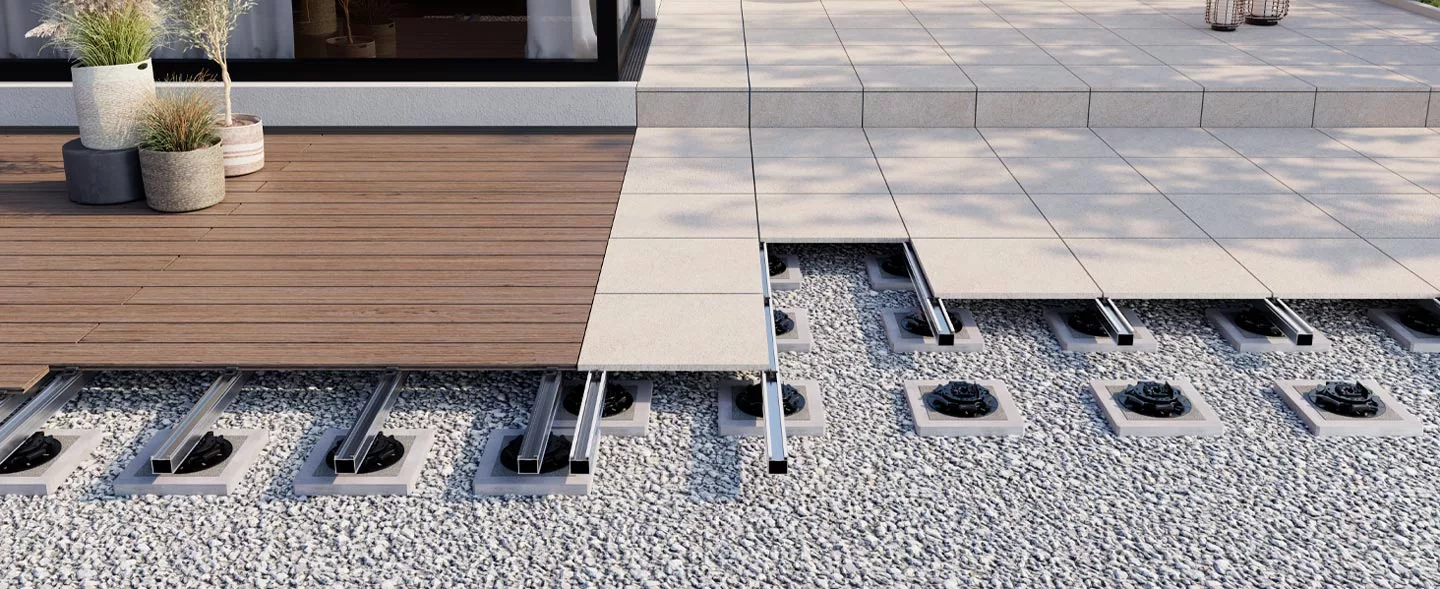

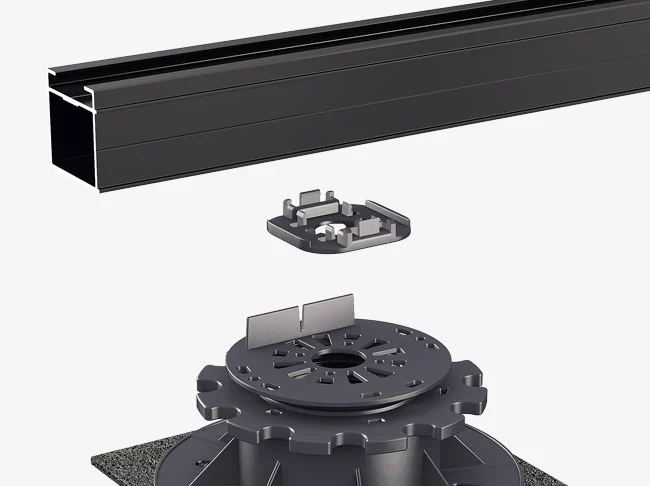
Aluminium ist langlebig, witterungsbeständig, wartungsarm und verzugsfrei. Die höheren Anschaffungskosten zahlen sich meist aus. Für eine Unterkonstruktion aus Holz eignet sich Lärche oder Douglasie, sowie resistentere Thermohölzer oder WPC (Wood Plastic Composite). Die Eigenschaften der Unterkonstruktion sollten zum Belag passen (Dehnungsverhalten etc.).
What is the best substructure for a patio?
Choosing the best decking substructure depends on various factors. Generally speaking, high-quality systems pay off in the long run, as they require little maintenance and do not need to be replaced after just a few years.
Factors to consider when choosing the substructure are:
The material used for the decking:
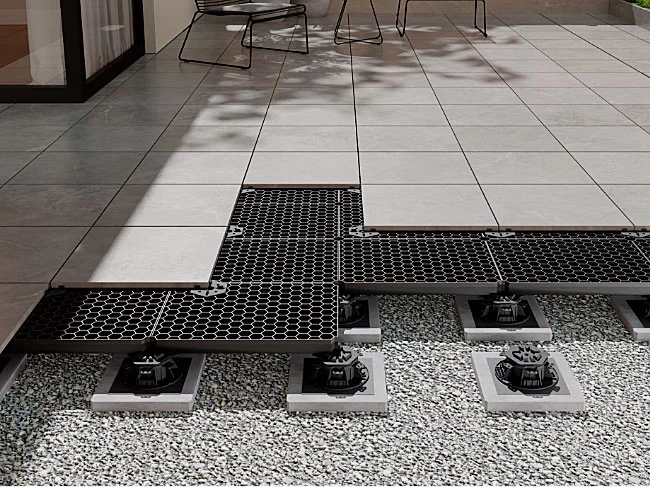
Depending on whether you are using wooden boards, natural stone, tiles or another material for your decking, the ideal substructure may vary. Heavy decking requires a particularly stable substructure with a high load-bearing capacity. For precisely laid tiled surfaces, where an exact joint pattern is essential, a warp-free substructure made of aluminium or grid panels (TRIAS WABIC) is suitable, as these allow for free-laying.
Climate and weather conditions:
In regions with significant temperature fluctuations, high humidity or extreme weather conditions, a robust and weather-resistant substructure is essential. The location of the terrace also plays a role. On south-facing sides, extreme heat can build up; on north-facing sides, damp persists; and on west-facing sides, the effects of the weather are particularly pronounced. Weather-resistant materials such as aluminium have proven their worth as a substructure.
Soil conditions:
The ground on which the terrace is to be built influences the choice of substructure. On firm and relatively level ground, the decking can be laid on a bed of gravel. Uneven ground can be levelled effectively using support struts. If large spans need to be spanned, heavy-duty profiles with a high load-bearing capacity, which require only a few support points, are suitable.
Budget:
Cost is a key factor when choosing the substructure. Materials such as aluminium or steel are slightly more expensive than wood or plastic. However, this investment usually pays off, as the decking will require very little maintenance, repair or, in the worst-case scenario, replacement. Damage to the substructure in particular can only be repaired at great expense. The cost of additional fall-through protection is also worthwhile if you wish to protect valuable tiled floors.
Installation benefits:
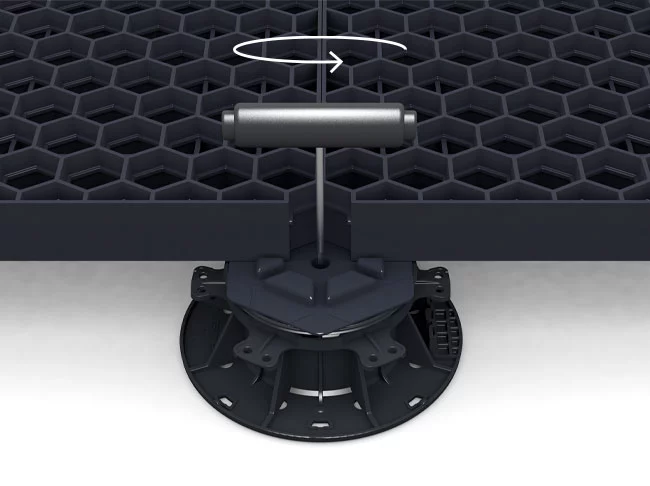
The installation and assembly of the substructure should be simple and efficient. It is also important to have considerable freedom in planning and a sufficiently comprehensive range of system components. Height-adjustable pedestal supports are practical, as they allow for quick levelling of uneven surfaces. Heavy-duty profiles with few support points can be aligned even more quickly. Slabs can be laid freely on a surface made of Trias-Wabic grating. Pedestal supports can be readjusted without lifting the grating panels.
Maintenance requirements:
Bear in mind the maintenance requirements, as you’ll want to enjoy your time on your patio with as little work as possible. Some materials require much more maintenance than others. Wood, for example, needs to be treated regularly to ensure its durability. Aluminium, on the other hand, is weather-resistant, does not warp and is resistant to mould and rot.
Local building regulations:
Ensure that the chosen substructure complies with local building regulations and standards. Permits must be obtained, particularly for the construction of roof terraces. The structure must be appropriate for the type of building.
Personal preferences:
Aesthetic preferences also play a role, as every terrace is tailored to individual wishes. Perhaps you’d like to combine a variety of floor coverings or extend your terrace with steps or walkways? The system should give you as much freedom as possible when it comes to planning. The best choice depends on the specific requirements of your project. It may be helpful to consult a specialist to find the optimal solution for your individual needs.
Welches Material für die Terrassen-Unterkonstruktion?


Wie stark muss die Unterkonstruktion für eine Terrasse mit Dielen sein?
Die Anzahl der Trägerprofile hängt bei Dielenböden von der Dicke und Tragkraft des Materials ab. Als Faustregel gilt: Nicht mehr als 40 cm Abstand für Dielen mit einer Stärke unter 2,5 cm. Für stärkere Dielen reichen 50 cm Abstand oder mehr. Die Eigenschaften der Dielen unterscheiden sich jedoch von Material zu Material. Vorschriften des Belagherstellers müssen in jedem Fall beachtet werden.
Wie berechnet man die Terrassen-Unterkonstruktion?
Die Anzahl der notwendigen Trägerprofile und die Menge des benötigten Zubehörs können Sie ganz einfach in unserem Online-Konfigurator ermitteln. In diesem lässt sich die Größe und Form der Terrasse sowie der gewünschte Belag angeben. Mit der jeweiligen Materialempfehlung können Sie den Bedarf schon sehr genau zusammenstellen. Wir empfehlen vor der Umsetzung mit einem Fachmann zu sprechen. Er kann auf besondere Begebenheiten hinweisen, wie beispielsweise auf zusätzlich benötige Rain-Grids für den Wasserablauf.
Welche Schrauben kann man für Terrassen-Unterkonstruktionen aus Aluminium verwenden?
Um Kontaktkorrosion bei der Verbindung mit anderen Metallen zu vermeiden sollte Edelstahlschrauben aus A2 oder A4 Stahl verwendet werden.

