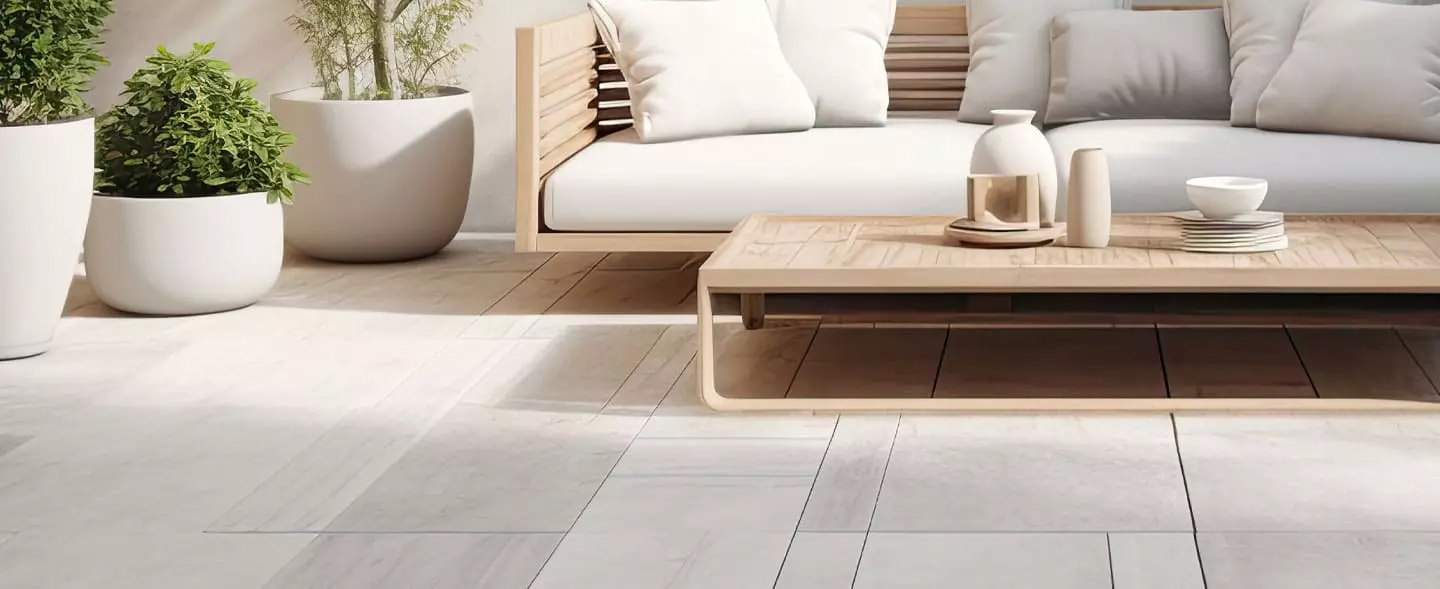
- Natural stone slabs offer a wide range of colours and textures for a personalised patio design.
- The TRIAS Wabic system ensures stability and protects the slabs from cracking and discolouration.
- The double-layer system, combined with a properly prepared sub-base, ensures weather resistance and frost resistance.
- Flexible laying patterns, such as Roman bond or herringbone, can be achieved with ease.
- Thanks to its lightness and load-bearing capacity, the TRIAS Wabic system also offers the ideal solution for roof terraces.
When it comes to stone paving slabs, a distinction is made between natural stone slabs, concrete slabs and porcelain stoneware slabs – the latter referring to ceramic slabs. The differences lie primarily in their visual appearance, the complexity of installation and the purchase cost. Natural stone stands out for its great variety – depending on the type of stone, terraces can be designed in a Mediterranean style or with a more minimalist aesthetic. Terrace surfacing in all shades of grey is currently popular. Granite is a popular choice here, as granite slabs are both affordable and relatively resistant to staining, making them easy to maintain. When laid in large formats, they create elegant surfaces that impress with their clean-lined aesthetic.
Many terrace designers opt for natural stones such as granite, limestone or travertine to give the outdoor area a thoroughly natural look. With their unique surfaces and textures, natural stone slabs create a particularly harmonious transition to the adjoining garden and impress with their individuality, as every natural stone slab is one of a kind. This natural character is emphasised by the patina that natural stone develops over the years.
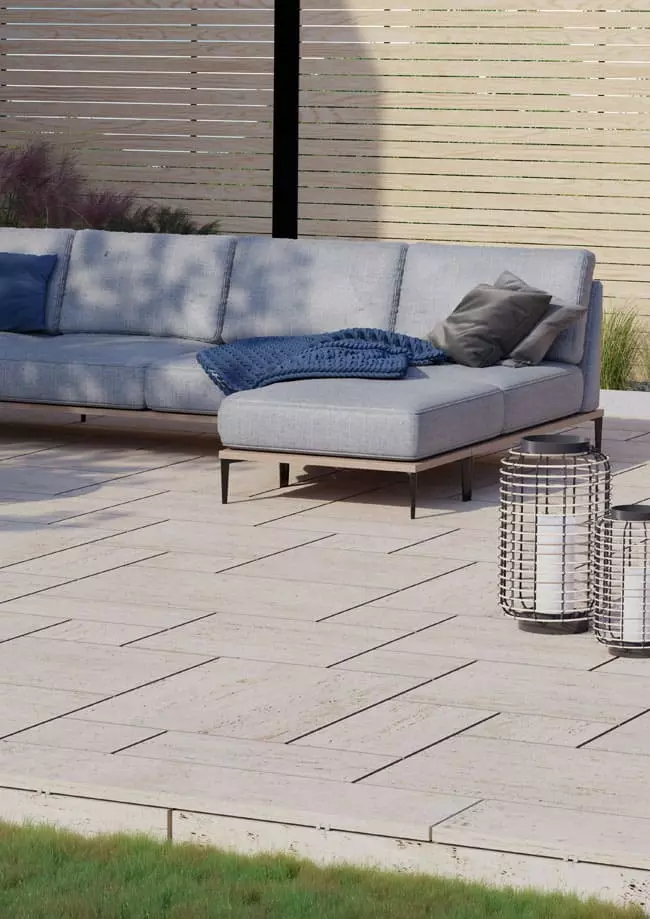
When laid correctly, this weather-resistant natural stone is completely frost-resistant, hard-wearing and fairly low-maintenance. Impregnation can provide additional protection. Whilst granite absorbs almost no water, some patio stones, such as Mediterranean travertine, have a slightly porous structure. When laying these, it is essential to ensure that no waterlogging occurs, so that the slabs are not damaged even at sub-zero temperatures. Water can collect and penetrate open-pored materials. In frost, the water that has penetrated expands and can lead to cracks and breakage. A gradient of 2–3 per cent is therefore always recommended for natural stone paving.
The slightly higher initial cost of natural stone slabs is offset by their durability and timeless appeal: a natural stone terrace will last as long as its owners, and is always an environmentally sound choice: the slabs are a purely natural product that can be quarried and cut to size directly at the quarry. Natural stones such as granite, sandstone and limestone, for example, come directly from Germany and can be processed into beautiful terraces. Environmentally sound and locally sourced.
Unlike ceramic slabs, natural stone patio surfaces are relatively heavy. For example, granite slabs 3 cm thick can weigh around 90 kg per m². If laid solely on a bed of gravel, slippage and subsidence can occur quickly. For this reason, the gravel bed is often combined with a special substructure to create a durable and particularly stable base for the paving, especially for larger areas.
This is where our TRIAS Wabic system comes into play; it has been specially developed for slab paving and can even support heavy natural stone slabs. On the one hand, the double-floor system supports and distributes the weight; on the other, it protects against breakage: natural stone patio slabs are stable, but can break due to external factors such as falling objects or excessive point loads. With pedestal supports in particular, there is a risk that, should a slab break, it will fall and cause injury. Weather conditions such as frost can also cause cracks and spalling, which may result in damage to property or personal injury.
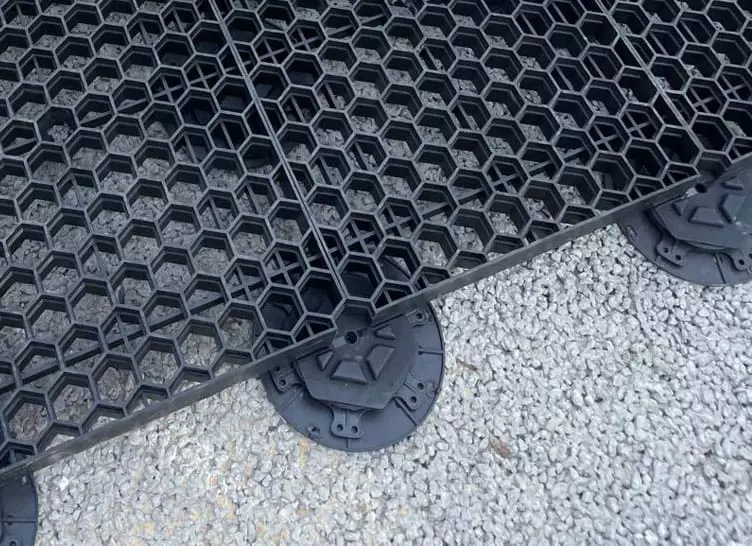
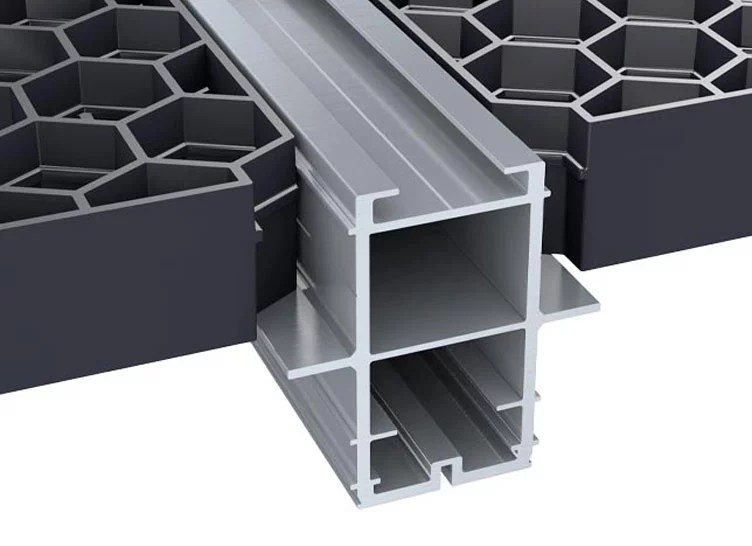
The risk of a slab breaking is therefore very real – this is where substructures with a double-deck system, such as the well-designed TRIAS Wabic system, provide protection: the basic elements of this system are so-called Wabic Boards made from sturdy polypropylene (recycled plastic). Thanks to the special honeycomb structure of the mesh floors, the risk of slab breakage is minimised, which is particularly crucial for large formats and high loads. The slabs rest securely on the mesh surfaces and are optimally supported.
Rainwater and condensation flow downwards through the open joints and drain away safely through the water-permeable Wabic grids. If the gravel bed is laid with a sufficient gradient, the natural stone dries out quickly and waterlogging cannot occur in the first place.
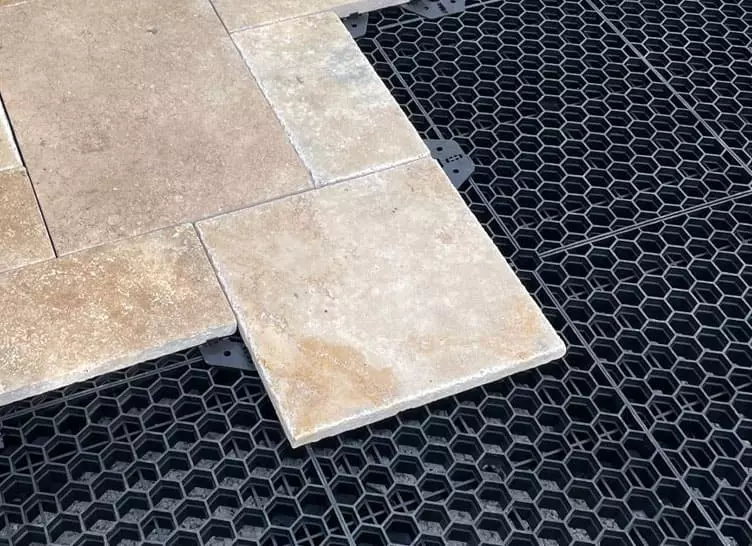
Another advantage of the TRIAS Wabic system is the great flexibility it offers during installation. Unlike other systems, the decking slabs do not simply rest on the corners but can be arranged freely across the grid surface. With the flexibly positionable X-Pads, almost all slab formats can be laid with ease and unusual slab patterns can be created.
How about ‘Italian-style jigsaw’? This refers to a laying technique that originated in Italy: the Roman pattern. The purpose of this laying pattern, which at first glance appears rather haphazard, was to keep construction costs and material expenditure as low as possible. The Roman pattern is ideal for natural stone tiles and, thanks to its dynamic appearance, emphasises their rustic and authentic character. A classic herringbone pattern or a block pattern are also easy to achieve.
Large-format grey granite slabs are often laid with a cross-joint: a wide joint further draws the eye to the laying pattern and the natural surface of the stone slabs, whilst a narrow joint creates a uniform surface – the key term here is ‘concrete look’. Good to know: The laying spacers (X-Pads) allow for joint widths of 2 to 4 mm, provide additional impact sound insulation and have an anti-slip effect. The slabs rest firmly on the soft pads – nothing wobbles, everything fits perfectly. This brings out the unique feel underfoot of natural stone flooring to its fullest.
Outdoor flooring made from natural stone develops a natural patina that brings out the vitality of the natural stone. However, many discolorations and stains are caused by improper installation. It is therefore helpful to know what the causes might be. Metamorphic natural stones such as granite, quartzite and marble, as well as sedimentary rocks such as limestone, are prone to permanent, usually black discolouration. Among the most common causes are humic acids in contaminated aggregate, as well as plastics and heavy metals in laying and grouting mortars.
These materials and substances can penetrate the natural stone when combined with a capillary-active environment, which is typical of many installation methods. Through capillary action, the harmful substances are transported into the fine pores and capillaries of the stone, where they can trigger chemical reactions and cause discolouration.
When laid on Wabic honeycomb panels, this risk is virtually eliminated. Thanks to the raised floor system, the paving is decoupled from the sub-base; the honeycomb panel itself is ‘chemically inert’, meaning it does not react, or reacts only to a very limited extent, to potential external influences. Not even to moisture or any cleaning products. A patina is desirable in natural stone; the right sub-structure helps prevent rust and mould stains!
If you want to provide optimum protection for your valuable natural stone slab flooring, combine the TRIA Alu Ultra heavy-duty profiles with the grating panels from the TRIAS Wabic system: this creates a perfect support surface for heavy natural stone slab flooring. This offers complete flexibility during installation and maximum protection against break-throughs. The heavy-duty profiles allow for spans of up to three metres. It is also a safe and smart solution for terrace extensions.
As already mentioned, some types of natural stone are susceptible to waterlogging. With the TRIAS Wabic system, the paving is rear-ventilated, which is a real advantage for your natural stone compared to ground-level installation.
The Wabic slabs also perform well when it comes to draining rainwater, although this requires a suitably prepared sub-base: the compacted gravel bed should have a gradient of 2–3 per cent away from the building to ensure reliable water drainage. To prevent unwanted plant growth, the gravel bed is covered with a root barrier. Concrete slabs, for example, are suitable as a solid base for the terrace, whilst support pads or height-adjustable feet are suitable for both support and levelling.
As a general rule, roof terraces and balconies must be able to withstand a load of 300 to 500 kg per square metre. If a heavy natural stone is chosen as the surface material, the substructure must be sufficiently lightweight. Weighing in at around 13 kg per m², the TRIAS Wabic system is a real lightweight and therefore the ideal substructure for balconies and roof terraces.
Installing the Wabic boards on a balcony or roof terrace is child’s play: the system’s pedestals can be positioned flexibly and are connected to the Wabic boards via an adapter. No tools are required to connect the boards to one another either; this is done by the connector clips. There is no need to lift the grating to readjust the height; a socket spanner is all that is required. Please note: Even on a balcony or roof terrace, an appropriate slope is required to allow water to drain into the guttering.
To ensure you can enjoy your natural stone paving for many years to come, you should waterproof your slabs once a year. It is best to apply the protective coating before the start of the new outdoor season – after that, sweeping and mopping with a little neutral cleaner is usually sufficient. Caution: Acidic cleaners based on vinegar or lemon juice can damage your natural stone. In winter, stay well away from road salt! It’s better to remove the snow the traditional way with a broom or snow shovel and, if necessary, scatter sand or fine grit over the surface.
With the TRIAS Wabic system, you’re choosing the ideal foundation for a durable, stable and visually appealing terrace with natural stone slabs. The combination of weather-resistant stone and the innovative double-floor system not only protects your patio from frost damage and slab breakage, but also allows for flexible laying in a wide variety of patterns. Whether it’s a classic garden patio or a roof terrace – the system’s lightness and stability combine safety with aesthetics. And when it comes to sustainability, your new terrace also cuts a fine figure.

